The High Price of Missing Out

Welcome back to another installment of Random Walk Theory. With winter now in full effect, I hope that all of you reading this are keeping warm and staying safe. It’s been a couple of weeks since my last post. I have been working on some new material but as with all good things, it does take time to eventually get to some sort of draft that you can be happy with. Despite the delay, we are indeed back. Hopefully we can pick up right where we left off.

In this article I’ll be talking about something I like to call, The High Price of Missing Out. This is a concept that I’ve been mulling over for the past few weeks but haven’t had the best way of conveying the idea. It’s a pretty powerful idea, in that it can help those who are currently feeling a bit on edge given how the market’s tend to react when the future becomes even more uncertain and opaque than usual. I’ve also had to evaluate my own portfolio given the recent moves in the market, and decided to spend some time thinking about how the current environment is affecting my decision making and what errors could I be making. After all, none of us can predict the future and we are a product of our environment and emotions. Losing money tends to be an emotional thing, and I am sure a few people have started getting itchy feet.

For the sake of perspective, longevity of this article, and to actually have a written down record of what was happening at the time, let’s take a quick look at what’s been going on:

  • South Africa has experienced a spike in looting and destruction of private property (mostly commercial real estate and some warehousing centres in Durban), which coincides with former President Zuma (79) handing himself over to serve a 15 month sentence, after he was handed the jail term after he failed to attend a corruption inquiry.
  • Different variants of the Covid virus have been found to be more infectious than previous variants, renewing fears of lockdowns happening again across the globe, which would derail the global growth recovery currently underway.
  • Government regulation on Tech companies has become an ever increasing theme, with more companies coming under scrutiny by various Governments around the world.
  • The Tokyo Olympics are currently underway, with stringent rules and regulations that I’m sure would render even the most enthusiastic fan to question their desire to be in Tokyo right in the first place (unless, you’re obligated of course)
  • Expectations of increasing inflation in the future has convinced some market players that the current economic recovery period is almost done, vs another group who believe that the economy still has a lot of room to improve. I believe that this is always happening (people love arguing) but it does seem to be more front and center now than usual.

Casting our minds back by 10 years, one would imagine that if you had received this list from the future, along with some of the other events of the not so distant past (Twitter hack, impeachment of Donald Trump), you’d be laughing at the absolute absurdity of it all. But, what life shows us is that the “unusual” tends to happen more often than not.

So, I guess the key question is, how do you navigate a world in which uncertainty is pretty much the only certainty? In today’s post I will discuss how I think about the markets in periods of volatility. I’ll be touching on some beliefs about markets & people and how they impact our decision making. I’ll then talk through a framework I use as a sense check, and relate it to one of nature’s best predators out there. I use this framework as a way to guard against my own biases and stay the course on my investment goals, especially when things get tense and I want to run for the hills and find safety. By remembering The High Price of Missing Out, I tend to get a better outcome, or at least a better sense of calm in knowing that I have gone through a process that works and is backed by some sound reasoning (at least I’d like to think so).

Some Realities to Deal With

Short term volatility tends to spook most, if not all investors at some point or another. The thought of seeing a massive negative loss over one day can send shivers down anyone’s spine and leave them with a sense of utter shock and despair. The fear of major losses is a pretty big deal, and when it comes to your own investments the topic becomes quite personal.

Now, one can imagine when you’re in an environment where things seem like they’re going to topple over and all is doom & gloom, the first thing you’ll be looking to do is find protection or take some (if not all) risk off the table. Investors face this battle everyday, with a constant barrage of “SELL”, “DANGER”, “FEAR” messages coming from both news networks as well as market feeds. The emotional rollercoaster of it all can leave most with a sense of anxiety and more often than not, lead to actions that may not be the best decisions.

When one is in a state of anxiety or stress, most decisions are taken in order to relieve the stress or anxiety that one is experiencing. That does not necessarily mean that that is the right decision when investing in the markets, or at least not a good decision until you have gone through a process to determine whether the action is beneficial to the Investment Outcome. Put differently, taking action against a risk that has not been fully weighed, considered within the context of the whole portfolio is a poor/less optimal outcome.

I believe that markets should be volatile to some extent, given the very nature and the make up of it. It is a universe of assets, with people who have varying ideas of what the value of these assets are. Because of these differences, one would imagine that people only buy or sell securities at prices that they think are worth, and because we all have varying ideas of what is or isn’t valuable, the accepted price range on a particular asset varies. When the variance in the price of the asset become wider, i.e. the opinion on the value of the asset tends to vary wider than usual, that is when we see melt up as investors all begin clustering around one notion of the price of an asset. I believe that these are the periods where fear or greed tends to grip investors and when we are in this state, less optimal decisions tend to be made. Especially when it its our money.

Coming to this realization, I needed to find a way to filter my thinking around my portfolio when things go pear shaped and guard my decision making process against making poor decisions when fear is driving my thinking, and where better to find a better teacher, but in Nature.

Return vs Risk – Thinking Like a Crocodile

Full disclosure, this section is going to need you to get a little creative in your thinking. If I can pitch this correctly, the message should be as clear as day 🙂

The crocodile has got to be one of the world’s most interesting animals to observe. A perfect killing machine that has roamed the Earth supposedly since the age of the dinosaur. It is one of the most ruthless hunters out there and has mastered the art of stealth and attack.

Now, I need to take the time to set the scene here….

Serengeti National Park - Home to the Great Migration
Source: http://www.serengeti.com

Imagine a river where we have many animals around its banks. These animals are either trying to cross the river, drink water or just cool off in the river. This is the environment in which the crocodile operates in. When things are normal and the banks are pretty empty, there’s not a lot of action going on. A lot of the time, the crocodile is not finding any massive opportunities to benefit from, and more often than not, it needs to work much harder to find a larger meal. I think of this in a similar way as when markets are “normal”… When things are normal, markets tend to be pretty average in their returns and you have to look pretty hard to find something that would produce outsized returns.

Going back to our analogy, lets take things a step further. Imagine that things begin to change in the crocodile’s environment. Something material that would be quite different relative to an ordinary day. Perhaps a Wildebeest migration (that would be different I reckon). In a situation like this, one would imagine that any other animal would adapt to the situation by running away, or steering clear of the incoming wave of Wildebeest, but where others may see danger, that’s when the crocodile springs into action…

Wildebeest Migration Crossing The Mara | Best Kenya Safari Experiences |  Art Of Safari
Source: artofsafari.travel

If we look at how the Crocodile hunts, we see some interesting things:

  • When hunting, the crocodile understands that patience is the name of the game. The success rate of the hunt drops, if it does not wait for the opportune moment; when all the factors align.
    • Lesson: Looking for winners and realizing great returns takes time and also requires the right environment for the asset to perform. If one can identify the right conditions in which an asset will perform well, then success should be the outcome, all else equal.
  • It’s opportunity lies in the impatience/greed/fear of the animal it is hunting.
    • Lesson: Market jitters or excitement provide good entry/exit points. If you are able to identify when markets are fearful or greedy, you are able to buy/sell assets at levels that would be considered abnormally cheap/expensive.
  • A crocodile aims to position itself in such a way that if there were to be any discourse or abrupt change, it would be to its benefit.
    • Lesson: Gaining a position where the biggest potential for a melt up could happen is advantageous. If volatility is expected, sit where the spillover effects are likely to take place.
  • A crocodile knows that even if there is some discourse (clamoring, pushing and shoving), it knows that this may not lead to an absolute jackpot every time.
    • Lesson: Not every hunt is successful. We may see signs of opportunity but it is also highly possible that these signals may not produce highly profitable results.
  • The most critical element in my mind is:

THE CROCODILE KNOWS THAT IF IT IS NOT THERE, IT WILL LOSE FOR SURE.

The demonic eye shine of an Alligator in a shallow Florida river) -  Jaw-dropping photos of one of the worlds most feared predators could not be  scarier. American photographer Larry Lynch captured
Source: telegraph.co.uk
Lesson: The High Price of Missing Out

In the analogy above, the key message and the core idea around The High Price of Missing Out.

Short-term volatility can often lead to investors selling their investments at the worst time. What data suggests is that trying to actually pull your money out of the market when markets crash actually ends up being detrimental to your overall returns since drawdowns tend to be followed by recoveries. Timing of markets is also very difficult to do and get right often, so building a trading strategy to try and identify the best days to be invested and best days to have no money in the market is nearly impossible. Not only because predicting the future is impossible, but predicting the future consistently is a task only the gods can be brave enough to pursue. So actively trying to manage money in such a way is most likely a bad outcome as you will have days where you are wrong and have the potential to do way more harm than good.

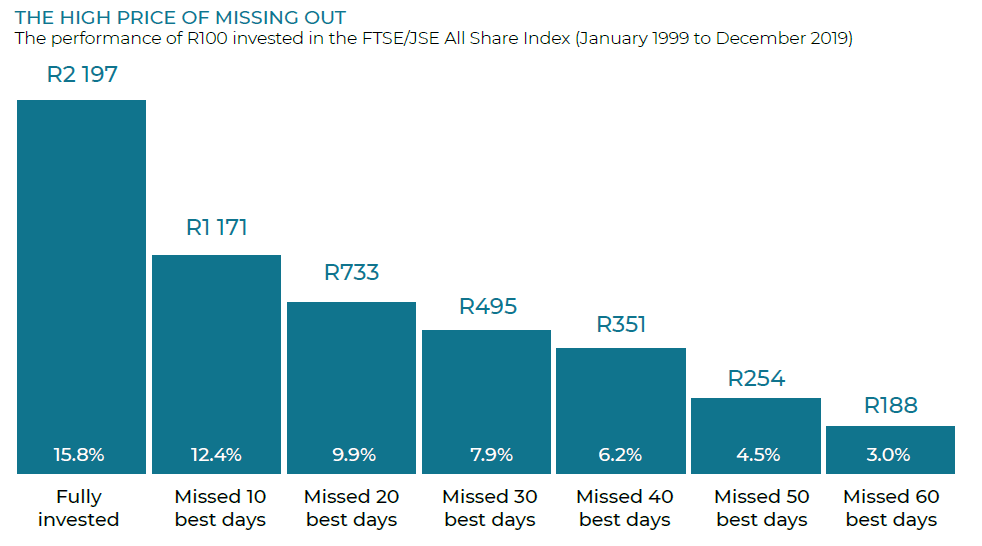
On the other side of the spectrum, sitting on the sidelines and missing those good days can be detrimental to your savings. Shying away from risk is detrimental to any long term investment goals as most riskless assets only produce a return at or below inflation. So complete risk aversion is not the ideal scenario to be in as well. Below is a demonstration of this. By missing out on the 10 best days of the JSE during a period of 20 years, you would be almost 50% behind on your potential return had you not taken the money out.
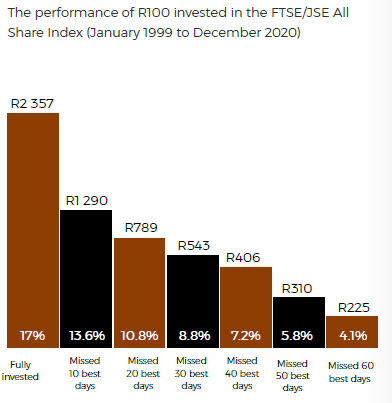
Source: MacroSolutions, Long Term Perspectives 2021

Consider the above to points of the spectrum, the sweet spot appears to be staying invested. By staying invested, you are actually still in the market, and therefore still exposed to the possibility of experiencing positive returns. IF YOU ARE NOT IN THE MARKET, YOU ARE GUARANTEED TO LOSE.

What is key is the assessment of the environment. If the environment is volatile but still supportive, you are still exposed to potentially higher returns, given that in times of volatility, excess returns can be generated as opinions on price vary quite drastically. If the environment is not supportive, then the potential for negative returns is higher. Positive environments should reinforce positive positive opinions on price, and therefore improve your potential returns, whilst visa versa for negative returns. This seems like a good framework when thinking about the current environment.

After going through this process when looking at my own investments, I am clearer on what is driving my perspective on risks and whether I should be acting or not. If I do not see any material change for the business case of a particular investment, then I am inclined to keep holding the position and potentially look to add more if I am able to get some more. Some fear volatility, others thrive in it.

Fortune only favours the brave 🙂

Until next time.

Thomo.

Wealth Creation: How I think about Investing

A reminder that this does not constitute as investment advice, and that the views held here are my own personal views.

Welcome back to another episode of Random Walk Theory. We are 6 months into the year and I hope that you are all thriving. A special thank you to all those who continue to spread the word on this blog. The support is highly appreciated. If you are new to the blog, welcome :), I hope that you enjoy the content and work put in.

In today’s post, I will be discussing my approach to Investments. This is different from savings (highlighted in one of my previous posts, Savings vs Investments: My Approach to Wealth Creation). I discuss how I think about Investments over the long term, what I am currently looking at and some ideas I am working on.

Perspective on Time Horizons

One of the most important factors to consider is your investment horizon. The amount of time you plan on investing will have an impact on the kind of risk you can and should be taking. The longer your time horizon, the more risk you’re able to take given that the money is not required for the short term. You can simply ignore any short term negative movements in the market as you are focused on the long term. In fact, in some instances those short term drops in prices present a good buying opportunity if what you’re buying is a good quality business/investment.

If we think about it using a simple example, consider a scenario where you need to pay R1000.00 for a good or service 3 months from now. This is a payment that needs to be made and is fixed. You can either put the money into an Equity fund (a mutual fund or ETF) or place it in a 3 Month Fixed Deposit and earn interest. Considering the fact that equity markets can be volatile over a short period of time (markets can move sharply over short periods of time due to market reactions to news flow, expectations being missed, FX flow, Trade News, Geopolitical Issues,… just a whole lot of random stuff), you could end up with less than R1000.00 over the 3 month period, leaving you in a worse off position. This is different to the other potential outcome of simply collecting the money from the 3 month fixed deposit and receiving the additional bit of interest that accrued over the 3 months. One investment is safer than the other, especially considering the fact that the time horizon is short.

Now consider the same example, but the obligation is now only due in 5 years. With more time on our side, the dip in the equity markets provides us with a cheaper price point, and given that the date for meeting our obligation is still far away, we are not exposed to the risk of failing to meet our obligation because it is much further out. The cost of taking the risk is lower. We are taking on risk, but the impact of the risk on our ability to meet our obligation is low.

My belief is that with time, you are able to take more risk and give the asset time to grow. The further out your obligation or goal is, the more risk you’re able to take because the impact of short term failures and drops now does not have a material impact on the ability to meet the obligation.

Building Purchasing Power
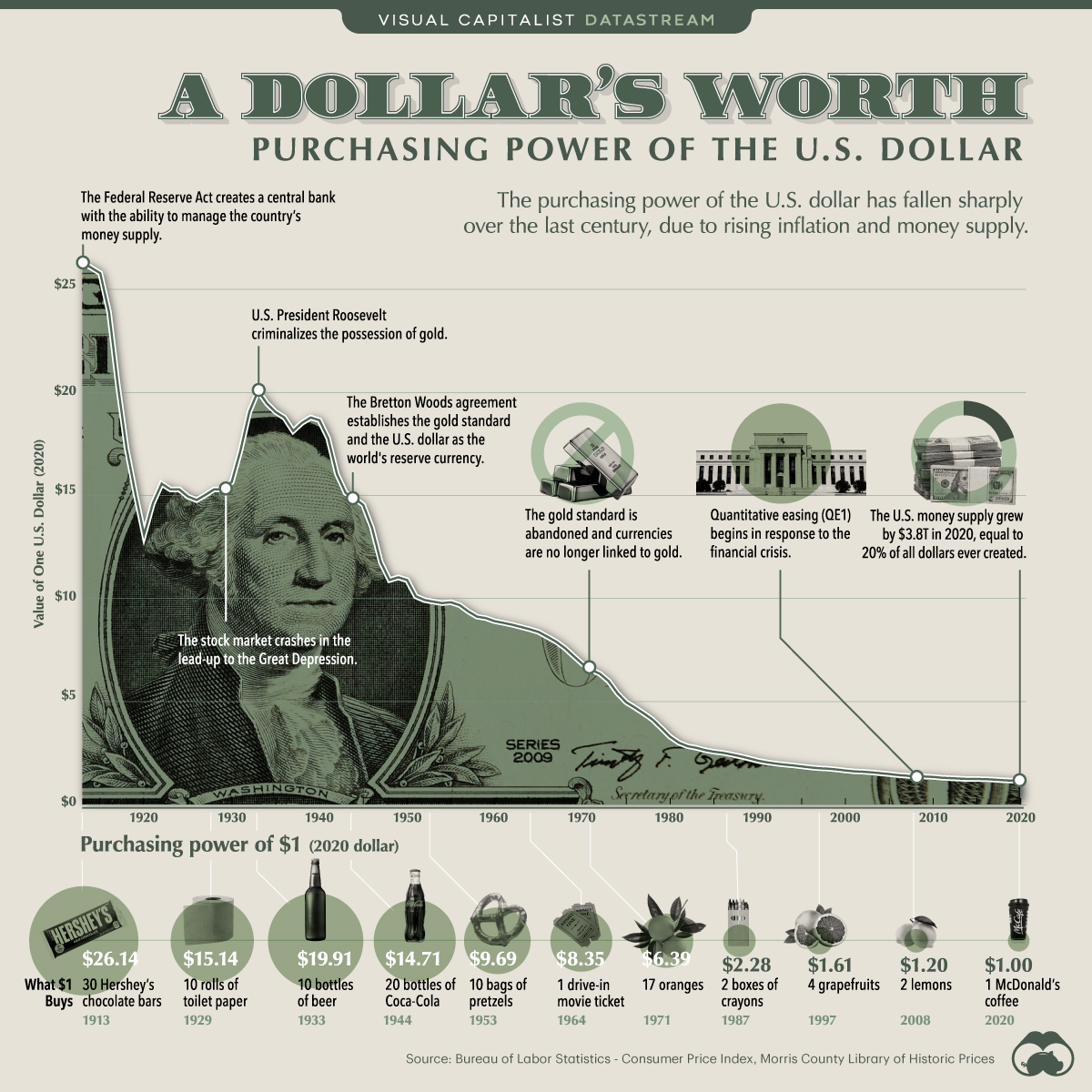
purchasing power of the dollar
Source: Virtual Capitalist

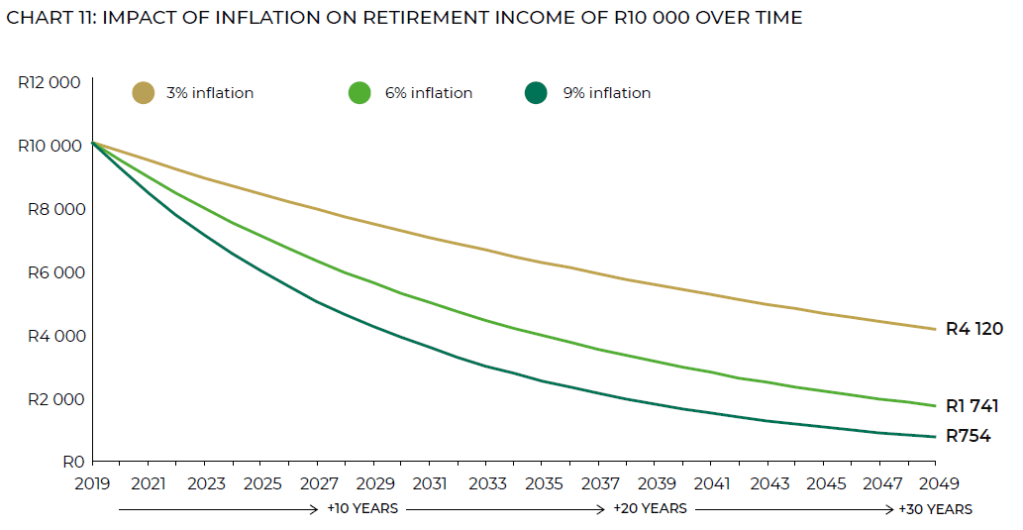
I also look to place my money in assets that can beat inflation. This is important as growing your wealth means being able to increase your purchasing power over time. You need to invest in assets that will not only allow you to buy the same amount of goods and services now, but will also grow your ability to buy even more goods and services in future, despite what inflation may have done to the cost of those goods and services.

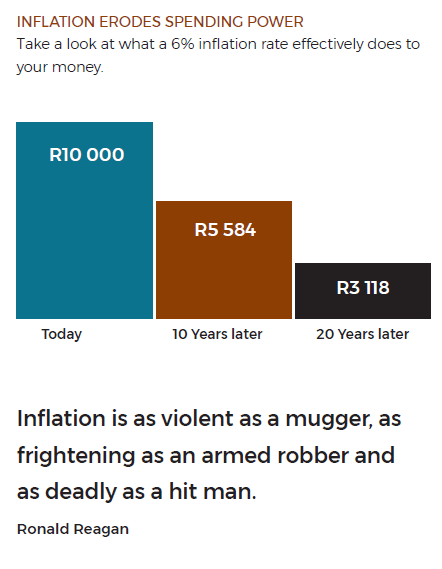
The chart below is a reminder of what inflation can do to your wealth.

Source: Long Term Perspectives 2021, MacroSolutions

Now, inflation over time tends to be well behaved and only spirals out of control in certain instances when looking at history. One can never predict when inflation will spiral out of control, one can only ever be prepared to try and beat it or protect against it if it does. This is done by being exposed to assets that tend to move with inflation or protect you against any adverse effects of inflation. I like equities in this regard. Equities have tended to provide decent returns over and above inflation when looking at history. Sure, there are periods where inflation spirals out of control that not even equities can cover the difference, but this occurs during extreme events such as economic depressions or wars. Over time, equities have provided returns above inflation, and considering long time horizons, tend to provide a stable return above inflation.

So… What does this mean for my Asset Allocation?

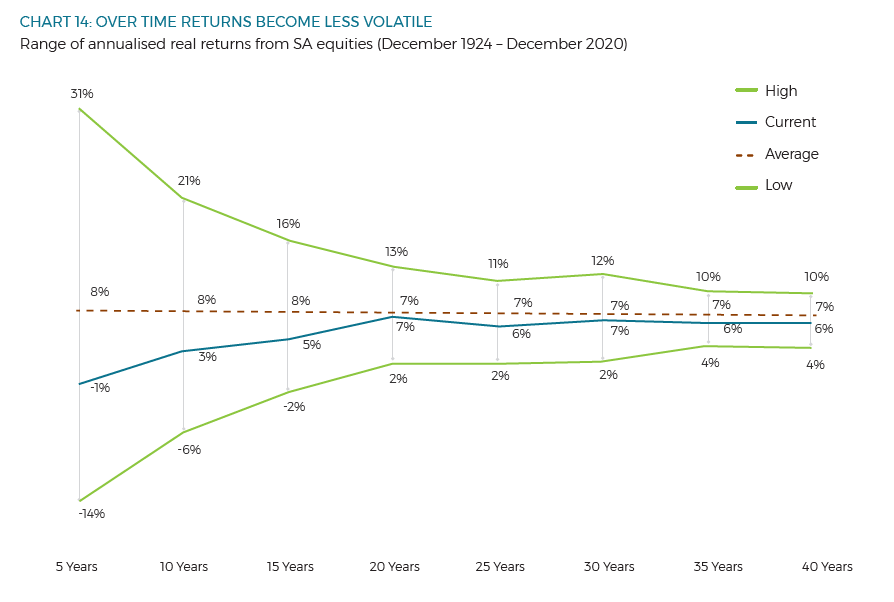
The base level of return differs across markets but on average, SA Equity as well as Global Equity tends to revert back to a yearly real return of about 7% a year for SA Equity and 7% (in USD terms) for Global Equity.

The chart below highlights this quite nicely for SA Equities. It is important to remember that investing is a long-term endeavor, and the chart essentially demonstrates the benefits of being patient and having a long time horizon.

This time funnel shows the range of the yearly real returns investors would have achieved over various periods (listed on the horizontal axis). The funnel (light green lines on both sides of the “Average” line) narrows from both the top and bottom as you increase the length of time invested, showing that time softens the impact of large positive or negative periods. Although losses can be experienced over shorter periods, history shows that long-term investors have been rewarded with positive real returns (these are returns above inflation), but only if they had the patience required to unlock that risk premium (the reward investors receive when taking on risky investments).

Source: Long Term Perspectives 2021, MacroSolutions

I prefer to invest in equities that will produce substantial returns over the long run and I like investing in funds that have aggressive mandates. This means that I like funds that are looking to grow my wealth by taking risk and hold positions in high growth companies or sectors. With my long investment horizon, taking risk is to my benefit because I have a lot of time to ride out the risk. This kind of approach also allows me to beat inflation over time as Equities tend to provide a return above inflation.

Thinking about it differently, most businesses tend to improve with time, especially smaller, more riskier businesses. As time passes, these companies grow their profits, become more efficient and grow in value. By investing early, you get to enjoy the growth phases of these businesses and see your wealth grow exponentially, versus being invested in an already mature, post growth business. You get to reap the rewards of taking on the higher risk.

Where am I hunting?

Given the fact that I like companies that still have some run way to go before they’re considered to be large companies, I am currently finding myself being drawn to the Small cap space. Companies that are considered to be smaller and more riskier than their larger counterparts should do well in an environment where growth is improving, the cost of capital is falling and the driving growth engine is working for that particular country. In my previous post, I highlighted why I believe South Africa finds itself in a particularly good sweet spot with growth surprising to the upside, commodity prices booming and the interest rate has been dropped quite substantially over the past few months. (Link: South Africa: Showing Signs of a Recovery)

A fund I like in particular is the Old Mutual Small Companies Fund. The fund aims to offer superior returns over the medium to longer term by investing in companies with a market value smaller than the company with the lowest market value listed on the FTSE/JSE Large Cap Index (J205). The strategy suits the way in which I like to think about my investments and aligns with my time horizon in that the fund aims to deliver superior returns over the longer term (more than 5 years). The fund also has a pretty good track record over time, and takes on positions that are meaningful in size, which is another aspect I like. I prefer to hold punchy positions in a portfolio as opposed to holding hundreds of different positions. You make money by taking good sized positions in companies that deliver good returns. Diversification is meant to preserve wealth in my view. Different strategies for different outcomes.

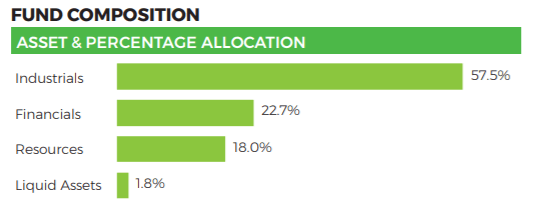
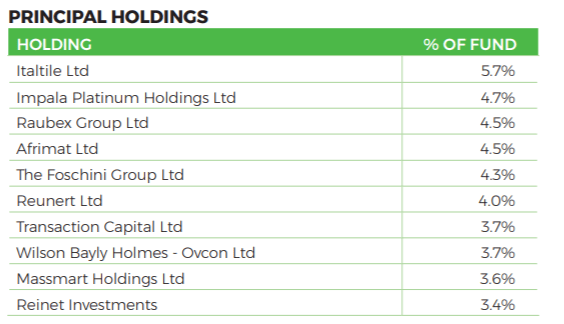
Looking at the make up of the fund, the fund is focused in areas that should currently benefit from the improvement in South Africa’s growth, particularly any growth that comes from a renewed infrastructure drive which the country has mentioned it plans on doing to get our potential growth rate up. A mix of businesses that I think should do well as South Africa recovers from its economic slump. Good punchy positions as well.

Source: Old Mutual Investment Group, Old Mutual Mid and Small Cap Fund MDD March 2021

Source: Old Mutual Investment Group, Old Mutual Mid and Small Cap Fund MDD March 2021

I do believe that as younger people who are in the capital formation stage of their lives, we should be taking on more risk in our investment portfolios, particularly when you consider the amount of time we have until we actually retire. Having an allocation to Small Cap equities is a great way to gain exposure to growing companies that are sensitive to the economic cycle and tend to reward investors over long periods of time. It aligns perfectly with long term investing decisions and is a great way of having exposure to high risk, high returns, whilst not being exposed to material impact on your long term goals (short term underperformance of small cap stocks has a small impact on your long term obligation/goal, as there is still a long time until you get there).

I hope you found this note useful. As always, feel free to share this and subscribe to the blog. Every new post will be sent directly to your mailbox.

Happy Youth Day.

South Africa: Showing Signs of a Recovery

Welcome back to another edition of Random Walk Theory. With the winter slowly kicking in, I hope that all of you have been keeping warm and enjoying the change in season. Once again, I’d like to send out a huge thank you to everyone who’s been sharing this site and interacting with the content. It’s really sharpening me up and pushing me to stay on top of things. If you haven’t already, subscribe to my blog (link: Subscribe) and get all the latest posts sent directly to your mailbox.

In this week’s post I’ll be taking a look at what’s been happening with South Africa’s economy. I’ll start off by describing how I think about the South African economy. I’ll then be taking a look at how various sectors have been performing over the past few months, what has been going on from a trade perspective and what I believe the prospects for South Africa’s economy are going forward.

A reminder that this does not constitute as investment advice, and that the views held here are my own personal views.

Thinking about our Economy

Whenever I think about where I want to invest my money, I try and understand how the underlying economy of that country actually works. I try and get an understanding of how this economy makes money and what are its drivers of growth. My belief is that you need to understand the core drivers of an economy if you are to fully understand how a company is impacted by being based in a certain country with certain constraints vs another, less constrained economy. I always try and get a sense of what really matters and what can be thought of as “noise.” This process gets a little tricky when thinking about South Africa because we all can fall for Home Bias, and I guess it’s polar opposite which I will simply call Foreign Bias. To define the two biases, let’s start with the former.

a Home bias is the tendency for investors to invest the majority of their portfolio in domestic equities, ignoring the benefits of diversifying into foreign equities.

So the polar opposite would be

the tendency for investors to invest majority of their portfolio in foreign equities, ignoring the benefits of diversifying into local equities.

So, considering all of this I always refer to a mental model of what I believe really drives South Africa and what really matters when thinking about investing my money here. I believe that what drives South Africa is commodity prices and Global Growth.

We are very much dependent on Global growth and particularly the Commodity cycle. When global growth is strong and the world is expanding, the demand for raw materials and metals drives a lot of production locally. In turn, this tends to start the flow of money within the economy. Given that the economy was essentially built on Mining and commodities, my belief is that all sectors are therefore leveraged to the Commodity cycle. Naturally, if your Industrialization happened during the boom of a commodity, then naturally everything around it gets built to benefit off of that. This sort of rationale makes sense to me, hence why I’m happy to hold it as fact. If no one wants industrial or precious metals, South Africa’s growth prospects tend to be quite dim. We are generally quite well diversified, but we still do rely quite a lot on the resource cycle to get economic growth to the broader economy going.

The cost of capital is also quite important in my view. The higher the cost of capital, the more difficult it is for companies to borrow large amounts of money for large scale projects given the borrowing costs involved. Described differently, it’s much easier to service the debt on a loan of R100 million when your interest cost is 5% vs 10% per annum. Added further to this, we tend to run a negative Current Account balance so we largely depend on offshore capital to fund this additional expenditure. When you need to attract foreign capital, you need to offer investors an attractive rate of return for them to fund your additional expenditure (this is the expenditure you have that is above your income, which is what the Current account essentially is when it is in deficit; a surplus works the other way around.)

So what’s been going on with South Africa’s Economy?
When Economic Growth Indicates Failure - YES! Magazine

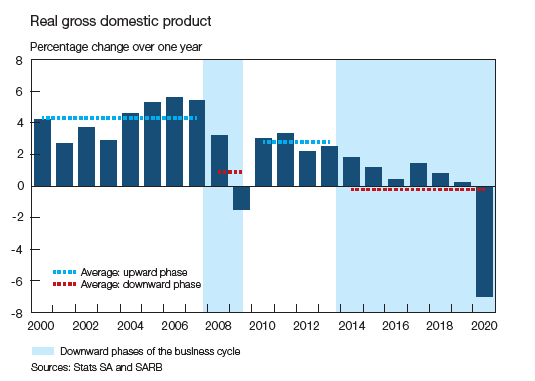
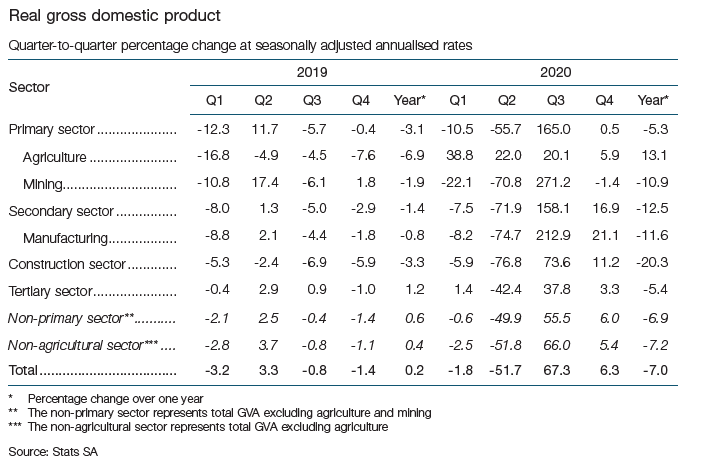
We begin by looking at what has happened over the past couple of months. With the closure of most economies around the world and the halt to most business activity locally, the economy took some massive knocks, with growth rates in certain sectors falling double digits. Looking at the economy as a whole, 2020 saw a big drop in GDP of 7%. The national lockdown-induced contraction in 2020 was the second-largest annual contraction since 1920, when real GDP fell by 11.9%, and was also about five times larger than the contraction of 1.5% that followed the global financial crisis in 2009. The decline in real GDP in 2020 consisted of a substantial contraction of 17.0% in the first half of the year and a recovery of 8.6% in the second half. The chart below shows how large this drop in GDP was relative to the previous year.

The table below shows the extent to which different sectors were hit. Looking at 2019 Year on Year performance, we see that most sectors were in decline already, with the exception of the tertiary sector, which held on at 1.2% growth. The last column which shows 2020’s year on year performance, we see that Construction, Manufacturing and Mining saw the biggest declines in growth, each seeing declines larger than 10%.

Trade: Looking at Exports and Imports

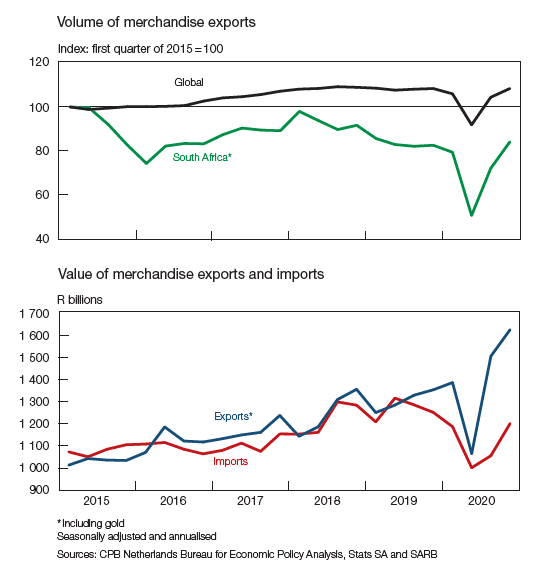
South Africa’s exports followed the further increase in global trade volumes in the fourth quarter of 2020, as trade continued to recover from the COVID-19-induced low in the second quarter. The value of South Africa’s net gold and merchandise exports surged further to an all-time high, while that of merchandise imports rose at a faster pace than in the previous quarter. The chart below describes this. In the first chart (top graph) we have the change in Export volumes of the world and South Africa. It is clear to see that although South Africa has lagged in terms of volume of exports, the recovery pattern is similar to the world’s expansion.

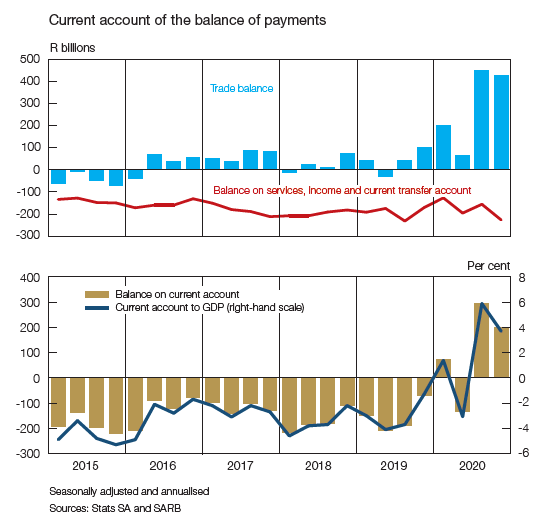
South Africa’s trade surplus narrowed to R425 billion in the fourth quarter of 2020, from the record-high R451 billion in the third quarter. The higher value of imports primarily reflected a sharp increase in volumes, while the increase in the value of exports emanated from both volumes and prices. The smaller trade surplus, alongside a sizeable widening of the shortfall on the services, income and current transfer account, narrowed the surplus on the current account of the balance of payments from R294 billion in the third quarter of 2020 to R198 billion in the fourth quarter, or from 5.9% to 3.7% of GDP.

On an annual basis, South Africa’s balance on the current account of the balance of payments switched from a deficit in 2019 to a surplus in 2020 in the midst of the COVID-19 pandemic – the first annual surplus since 2002. This outcome can largely be attributed to a significant increase in the trade surplus due to an improved export performance, which was supported by higher prices. At the same time, weak domestic demand alongside a sharp decline in crude oil prices weighed down the value of merchandise imports, while the shortfall on the services, income and current transfer account also narrowed. Consequently, the current account of the balance of payments switched to a surplus of 2.2% of GDP in 2020, from a deficit of 3.0% in 2019. The chart below shows how the Trade Balance has been a positive contributor to our Current Account balance.

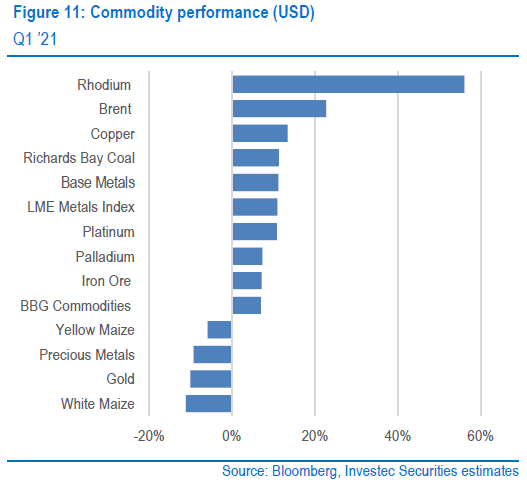
Put in a different way, South Africa has benefitted massively from the recent run in Commodity prices, with precious metals, coal and iron ore performing well whilst our biggest import, oil, has seen a much more mild recovery. This means that we are generating more money from our exports whilst paying less for the imports we buying, leaving us in a net positive position, hence the positive Current Account balance. Over the past 5 years, our export basket has seen massive increases in value. The chart below, indexed to 100 in early 2015, shows the growth in precious metals over the past 4 years. Commodities like Rhodium have gone absolutely bonkers over the past few years as demand for metals that assist in cutting carbon emissions in vehicles gathers pace.

Coming back to my earlier beliefs on how South Africa works, this is a positive development in the way I view South Africa. An environment where precious metals and industrial metals are in high demand whilst oil is cheap spells positive growth in my mind. The environment is supportive for South Africa in that we can make money off our exports and get the economy going again given that most sectors thrive when money is being made from the Mining sector. A prolonged period of strong commodity prices should benefit South Africa from a growth perspective.

Cost of Capital: Interest Rates are low; no expected hikes

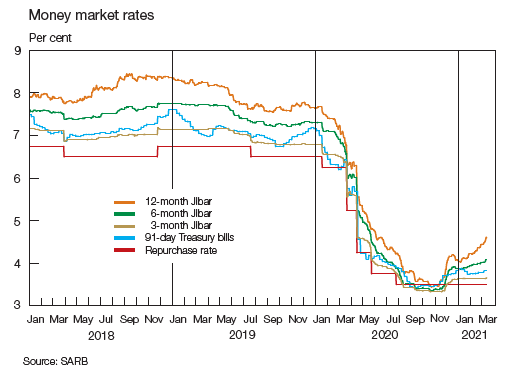
South African interest rates have been falling for much of the past year, seeing the current repo rate near historic lows. The repurchase (repo) rate was kept unchanged at a historically low 3.50% in January and March 2021. The SARB’s Monetary Policy Committee (MPC) cited a number of key challenges facing the domestic economy, including the continued negative impact of COVID-19, while the overall risks to the inflation and domestic growth outlook were viewed to be balanced.

Below is a snapshot of where interest rates are. Over the past few years, we’ve seen interest rates go from 8% to 4%. This means that the current interest rate that you are earning on a simple money market account with your local bank is half of what it used to be 3 years ago. Investors who would typically be happy earning 8% now have to move money into more riskier assets to earn a higher yield. There are other options that aren’t high risk, and are currently offering a good yield. (see my other notes on SA Government Bonds: South African Government Bonds: An Introduction, South African Government Bonds: How I think about the asset., South African Government Bonds: Inflation Linked Bonds)

On the other side of the coin however, this is positive for those looking to borrow to increase capacity or fund their business in case there is a need for expansion or a profitable opportunity comes knocking. At lower interest rates, the cost of capital is lower and therefore businesses are able to fund their projects at better rates. This is positive for a country that has historically had relatively high interest costs on debt over the past few years.

Is this the Perfect Storm?

With strong external demand, low interest rates and a global economy that is slowly on the recovery, I do not see why this is not South Africa’s opportunity to take advantage of the upswing in global growth. With a supportive commodity cycle, South Africa can get the economic recovery on the way and get some much needed internal demand going. Again, the way in which I believe the South African economy works leads me to see that this is could be a positive cycle for South Africa. It provides us an opportunity generate some revenue and hopefully use it to rebuild infrastructure and increase the capital stock required in South Africa to grow. It appears to me that the current environment is the best suited environment for South Africa to grow meaningfully, relative to the past few years where we have seen benign growth.

Hopefully this could be the start of good run for South Africa.

Now, to find some winners…

Until next time 🙂

Thomo.

Macro Perspectives: What’s behind the Rand’s strong performance

Check out some interesting Macro Perspectives from Peter Brooke, Portfolio Manager from MacroSolutions. He shares some insights into what has driven the recent Rand strength and how we have been thinking about allocating money to South African assets vs Global assets

Savings vs Investments: My Approach to Wealth Creation

Hi everyone 🙂 . Welcome back to another episode of Random Walk Theory. In today’s post we discuss something that is at the top of most people’s mind given the recent interactions I’ve had with a few readers. We discuss Savings and Investments. A topic that gets most people nervous or excited, depending on which end of the spectrum you find yourself (and what your current bank balance looks like.) It’s a topic a lot of people feel nervous about because it is a place of unfamiliarity. Most people haven’t been exposed to an actual budgeting process until they reach their first pay cheque. The only real concept most people have of it is a small module either covered in Primary or High School. Yet, the ability to save and invest is one of the most important things to understand.

I’ll be starting off by sharing a bit of my Savings and Investments journey over the past few years. I’ll then be discussing the difference between Savings and Investments. I’ll spend some time talking through my approach to both Savings and Investments and pass on some useful tips and tricks I’ve used to keep my consistency up.

Let’s dive right in.

Reflecting on my Journey so far…

The idea of Saving and Investing is something most people have a general appreciation and understanding of. People do understand the concept that putting some money away for a rainy day or for a big expense item is a logical thing to do. The problem is figuring out how to do it. This makes the idea much more daunting for people than what is made out to be believed.

A couple of years ago when I started working, I also found myself in this predicament. I started out not having a real plan. I had a “we’ll see as the month goes by, as long as I have paid off the basics” approach to expenditures. I had just started my first job and didn’t have any responsibilities to really look out for. I figured since I had a Pension plan from work, that I am already doing enough in terms of savings. I was also new to Cape Town so I was keen on having fun and experiencing this new city. It was all about the Vibes to be honest. To put it bluntly, this is where I was in terms of my financial astuteness:

  • Never had an explicit amount of money that I wanted to save per month.
  • No real anchor around my spending on Groceries, Entertainment and Going Out etc. I was pretty much allocating as I saw fit.
  • I did most of my record keeping in my head. I used a “Mental Accounting” approach vs having things down on paper or on a spreadsheet somewhere.

Looking back with hindsight, this was very counter-intuitive given that I had just started working in the Asset Management industry. Luckily, my perspectives changed due to the people I had around me and as I started developing a deeper understanding what the industry I worked in was really about. I began to really develop a philosophy around savings and investments and began looking at my relationship with money.

My belief is that being Wealthy is more linked to having the right behaviors with money vs having lots of money, which ends up being an outcome of your behavior with money. Being able to harvest savings from just about any level of income is a mark of a true money manager in my eyes. Knowing where to allocate spending and capital, given whatever constraint, is true money management. In order to be able to do this, you need to understand what actions you’re taking and also have a few rules in place to keep you on the right path.

So lets start with the basics.

The difference between Savings and Investments

Before we embark on a journey towards financial independence, let us first understand the basics of savings and investments. A disciplined investor creates a balance between the two.

Saving is the process of parking cash in extremely safe and easily accessible assets. The primary aim should be capital preservation and the secondary goal getting some returns, if possible. This can include savings accounts and even just keeping money on hand in a regular transactional bank account.

Investing is the process of using money/capital to generate a safe and acceptable return over a time-period. An investment can include real estate, gold coins, stocks, mutual funds and small business to name a few.

Let’s take a look at the main differences between Savings and Investments:

SavingsInvestments
Savings are ideally smaller, for short-term goals in the near future like a vacation, emergency etc. The time horizon on this is usually short (less than 3 years).Investments involve putting money to work to create wealth for achieving long-term goals like child’s education, house etc.. The time horizon is typically longer term (5+ years)
Liquidity is high, giving ready access to cash when needed. This means that you can access your money with very little difficulty and a in a quick turn around time.Liquidity is usually lower than Savings, given that some investments may need to be invested for a few years, or have “lock in” periods. This isn’t the case with regular Unit Trusts or ETF’s.
There is typically no risk involved. Most banks offer a guarantee on your capital.Risk involved is usually higher than a standard savings account. This is because you’re exposing your money to different factors within the economy and there is no underlying guarantee of protection.
You can earn interest on your savings. The interest earned on most savings accounts is low and barely beats inflation. This is the price for safe assets. More safety usually comes with less return on offer.Investments have a potential to yield higher returns, where investments appreciate over time. These are the assets that tend to offer higher return given the fact that more risk is embedded in them.
My approach to Savings

When I think about my Savings, I like to make it as seamless and boring as possible. When I say boring, I mean that I don’t try get too cute and clever with my method. I leave all the thrills and spills for my Investment Portfolio that I manage (Hopefully we’ll have a dedicated post on my portfolio soon). I prefer to keep it simple and classy.

As a starting point, I believe that everyone should have some sort of Scoreboard for their Income and Expenses as well as their asset and liability base. The first step to saving is actually knowing how much you’re able to save and what your current level of saving is. Knowing how much money you have saved where it is is critical, otherwise you’re flying blind. Having your scoreboard allows you to get a better picture of what needs to be sorted out. If you know the state of your finances, then can you start cutting the fat where it really matters. This can be in the form of a budget, or having some useful Finance apps that consolidate your income and expenses into different groups.

The next step is to decide on a Savings Rate. This is the percentage of your take home pay that you allocate to Savings and Investments. I like to think of it as a rate at which your harvest a part of your own income for yourself. Our salaries are always leaving our pockets one way or another and paying someone or something else, so having some percentage of it coming back to you is important, and I don’t think a lot of people think about it that way. Having a figure that you target as a percentage of your income is useful in that there will always be some level of harvesting at various levels of your income. I believe that its a realistic way of growing your wealth in a manner that is consistent with your income level. Finding the balance is key.

I’ve used a Savings Rate of 30% over the past few years as a straw man to make sure that I have a consistent number I always target when looking at my monthly savings and investments allocation. I found that a higher savings rate was possible, but it wasn’t really any fun for me. I believe in also allocating some money to fun, because Life is meant to be lived and enjoyed. My view is that you need to have a balance of both saving but also allow yourself to have some fun. Tailoring a number that will be meaningful (I found that at minimum, everyone should have a savings rate of 10%) but will also make the behavior sustainable over a long period of time (I tried 40%, but became frustrated when I didn’t have enough money for other fun things) is the best way to keep consistent and honest with yourself.

The 3rd step is setting up an automatic debit order and sending the money straight through to a Savings Account. I use the analogy “Death by 1000 cuts” as a way of making this concept make sense. Everyone hates debit orders coming in a few days after pay day. My view is that if you already have 3 or 4 debit orders coming at the end of the month, you may as well add an additional one, but this time this debit is FOR YOU. ALWAYS PAY YOURSELF FIRST !!! The “pain” of the other debit orders has already happened, so the addition of 1 more doesn’t add a massive amount of “pain” already experienced. If you’ve already taken the pain of the other debit orders, you may as well take an additional knock but this time, the money taken off is actually for you. This is my “Death by 1000 cuts” analogy. What’s one more cut when you’ve already had 900?

My approach to Investments

As a starting point, I need to give you my perspective on Investments and how I look at it currently. I consider myself young and I have a long investment time horizon when I think about my actual time to retirement (still have +30 years to go) so my approach is based on this fact. I also look to place my money in assets that can beat inflation. This is important as growing your wealth means being able to increase your purchasing power over time. You need to invest in assets that will not only allow you to buy the same amount of goods and services now, but will also grow your ability to buy even more goods and services in future, despite what inflation may have done to the cost of those goods and services.

The chart below is a reminder of what inflation can do to your wealth.

Source: Long Term Perspectives 2021, MacroSolutions

My view is that with Investments, time is your friend. If you have a long time horizon, you are able to ride out short term market moves and allow your investments to grow over time. Short term market movements shouldn’t worry you as you have a lot of time to see the market correct and go on to produce positive returns. Any short term disruptions can be viewed as an opportunity to buy assets that have now become cheaper. I have used market falls as an opportunity to by more of the assets I like and which I think will still go on to make positive returns.

Over the long term, Equity performance tends to return to some baseline average return. This base level of return differs across markets but on average, SA Equity as well as Global Equity tends to revert back to a yearly real return of about 7% a year (in ZAR) for SA Equity and 7% (in USD terms) Global Equity respectively.

The chart below highlights this very nicely for SA Equities. It is important to remember that investing is a long-term endeavor, and the chart essentially demonstrates the benefits of being patient. This time funnel shows the range of the yearly real returns investors would have achieved over various periods (listed on the horizontal axis). The funnel (light green lines on both sides of the “Average line) narrows from both the top and bottom as you increase the length of time invested, showing that time softens the impact of large positive or negative periods. Although losses can be experienced over shorter periods, history shows that long-term investors have been rewarded with positive real returns (these are returns above inflation), but only if they had the patience required to unlock that risk premium (the reward investors receive when taking on risky investments).

Source: Long Term Perspectives 2021, MacroSolutions

I therefore like to take on as much Equity exposure as possible. I prefer to invest in equities that will produce substantial returns over the long run and I like investing in funds that have aggressive mandates. This means that I like funds that are looking to grow my wealth by taking risk and hold positions in high growth companies or sectors. With my long investment horizon, taking risk is to my benefit because I have a lot of time to ride out the risk. This kind of approach also allows me to beat inflation over time as Equities tend to provide a return above inflation.

There are many approaches to investing and I think that it isn’t a “One Size Fits All” exercise. We are all different and have very different views on risk taking and what our time horizons are for our investments. What is important is that you have a plan. Working with a plan that suits your needs and is realistic is important. In my view, this is the key to sustainable investing. It is much easier to stick to an investment plan when it suits your needs and also doesn’t leave you feeling anxious. As with almost anything, patience is key.

Hope you found this useful. If there is anything you’d like me to expand on in another post, or you’d like for me to tackle another topic of interest, feel free to let me know 🙂

Until next time.

Thomo.
2021 Q1 Market Review: South African Equities find their Sparkle

Welcome back to another edition of Random Walk Theory. I’d like to take this opportunity to celebrate the fact that this is the 10th post on Random Walk Theory (I hope that you noticed). A small win, but a win I am proud of. Thanks to the readers who’ve been with me on this journey since the first post, and all the engagement I’ve been getting. Some really cool stuff has come from the conversations and hopefully they’ll manifest into further posts.. I’d also like to welcome those who have wandered over here (and thank the force that drew you here), I hope you enjoy the posts and find them useful. Finally, I hope that all of you had a great Easter weekend and got some rest.

In today’s post we will be doing a market review of the 1st quarter. This is the first market review on this blog so best to bed down some structure so that we have a framework for future posts. In order to do the analysis, we need to make sure that we are reading all the returns in one common currency. For the rest of the post, returns will be discussed in USD terms, unless stated otherwise. This allows us to compare different countries using 1 currency as opposed to representing returns in different currencies. We will begin by discussing the performance of different equity markets over March. We take a look at South African equities in some detail and look at which sectors performed well and which sectors lost out. We will then look at performance over the full quarter and have a look at which assets performed the best and who were the losers. Finally, we will have a look at some stuff I found very interesting and I’ll discuss some thoughts around them.

Let’s get stuck in.

Performance over March.
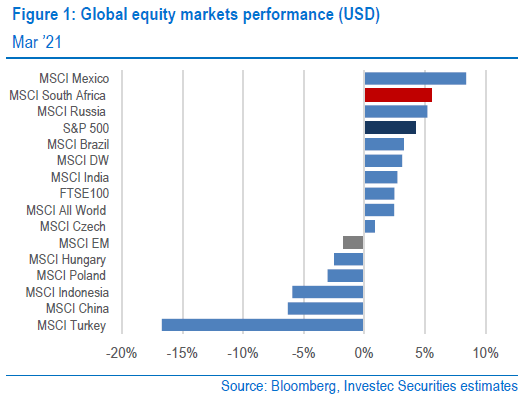
  • South African equities have been quite strong over the past month. When looking at South African equities relative to other global Emerging Market peers, we come out as the second best performing stock market over March. Mexico is currently leading the pack after having a strong March.
  • South African equities have outpaced several peers including Russia, India, Brazil and has also outperformed the S&P500 in USD terms. That means that if you held SA Equity this past month, you made more money in USD than someone holding US Equity.
  • On the other side of the spectrum, you have Turkey and China’s equity markets taking a bit of a dip. Political risks in Turkey have always been detrimental to their currency and during March we saw some Turkish Lira weakening. Chinese stocks have also dropped given recent scrutiny around Tech businesses having such a massive impact on public sentiment and influence. Efforts around more regulation in the sector spooked investors and has driven the Chinese index lower.
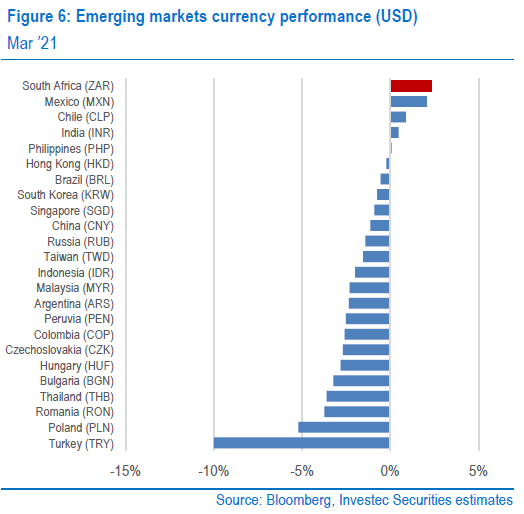
  • Looking at currency performance, the ZAR has been the star performer amongst Emerging Market peers. Mexico has also held its own, coming in at 2nd place. The past month saw the Dollar gain some strength so a lot of currencies have lost over value over the month. The ZAR and Mexican Peso were able to keep their heads above water and saw small, but positive returns. Looking at the losers, Turkey stands out with a loss of close to 10%.
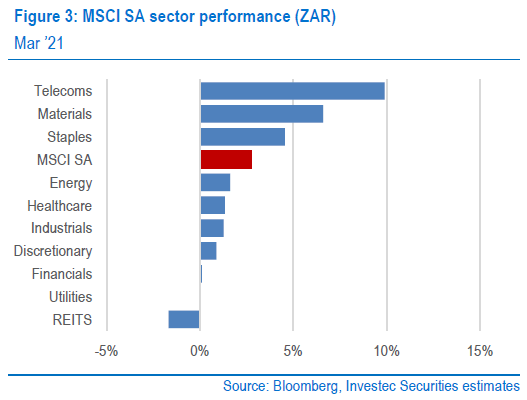
  • Looking at sector performance within the South African market, Telecomms, Materials and Consumer Staples outperformed the index itself. Looking at the losers, REITS (Real Estate Investment Trust) continued to disappoint investors, as lockdowns and Working From Home strategies have decreased foot traffic in the malls and left many office parks vacant. Plenty of headwinds are expected but with vaccination programs on the way, we should be coming to the end of such poor performance.

The charts below highlight the comments made above. The first chart highlights the global equity performance over the month of March for a variety of Emerging Markets. In USD terms, South Africa returned just above 5% over the month.

Below is a picture ofFX performance over the month. Along with Mexico, South Africa’s Rand held up well relative to other EM peers.

Looking at Sector Performance below…

Performance over Q1 2020
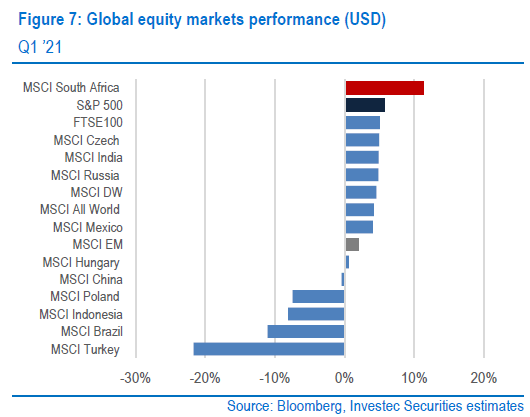
  • South African equities have found their sparkle once again. The MSCI SA Index was the star performer when looking at its performance relative to other Global markets.
  • To give you a sense of SA’s performance, the MSCI SA Index outperformed the US Large Cap Index (S&P 500), MSCI Taiwan’s tech-heavy index, the UK as well as the MSCI World Index.
  • With the mix of Materials, Oil and Tech, South Africa has almost been “The Best of Breed” when looking at the make up of the index. Combined with a relatively stable ZAR, we saw great performance over the first Quarter of the roaring 20’s. The exposure to commodities has also been instrumental in driving our returns as a market.
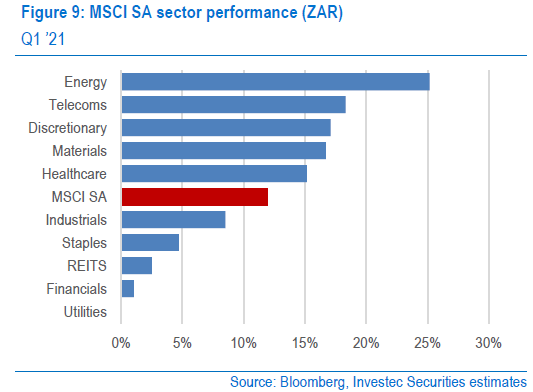
  • Looking deeper into the different sectors that make up the MSCI SA Index, we see that the recent performance of Oil, Telecomms, Materials and Discretionary Consumer sectors have been driving the index performance. On an even more positive note, we see that all sectors within the MSCI SA Index basket all had non-negative returns. It seems as though SA’s market saw a broad based lift.
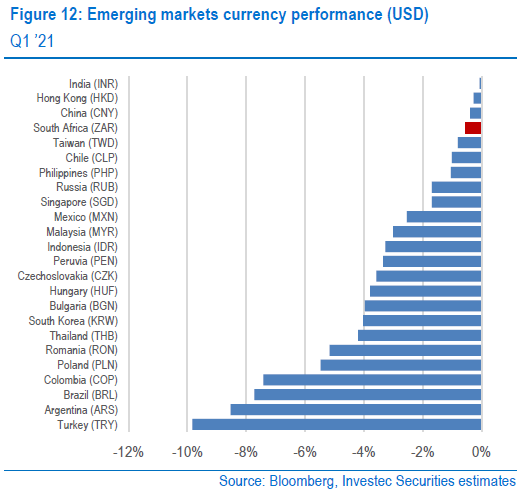
  • From a currency perspective, most currencies have lost some value relative to the dollar as a recent rise in interest rates in the US as well as a rise in growth expectations have caused the USD to strengthen. Given this, the ZAR has been able to hold its own and only experienced some slight weakness against the Dollar, but has done very well relative to other Emerging Market currencies.
  • Looking at some of the losers, it appears the isolated political issues have been the main reason for Turkey and Brazil’s recent under-performance from both a currency and market perspective.
  • Both countries have seen political risk increase as members of important institutions were sacked. One can recall when we experienced the same rise in political risk when our Finance minister was suddenly fired and replaced by someone who no one seemed to really know, which led to a massive spike in our Government Bond yields as well as the currency. Such random political flare ups tend to remind investors that in many Emerging Markets, you tend to see some unorthodox policies that aren’t similar to your own, and there lies the risk.
  • What was interesting to me was the lack of response in the ZAR to this. One would think that if there’s a spike in EM risk, the ZAR tends to sell off as well but it seems as though the ZAR has been able to miss out on much of this “contagion risk” from political flare ups in Turkey and Brazil.
  • Finally, looking at the Commodity basket space, South Africa’s export basket of Precious Metals as well as Industrial Metals all saw positive increases in value over the first quarter. This is positive for South Africa given that we are still a commodity-based exporter and commodity prices matter for growth in South Africa.

Below are some charts highlighted what is mentioned in the list above.

First, we look at the Equity index performance, in USD. South Africa’s market has found its way to the top of the table, with its mix of Tech, Materials and Industrial companies that have benefited from a recovery in Global growth.

Below is a look at the returns of the different sectors within the MSCI SA, the returns are stated in Rand terms and not in USD

Having a look at currencies, the ZAR held up pretty well in the face of USD strength as well as increased selling of Emerging Market assets.

And finally, a look at our commodity exports. We see some solid positive movements in our export basket. Rhodium has absolutely shot the lights out, and all other industrial metals have done pretty well. Overall, this is supportive for South Africa’s Trade Balance. Oil has also increased, which tends to be passed through into the economy via higher fuel costs, but for now all other exports are performing well.

Summary/Outlook

Overall, things are looking pretty good for South Africa from a market perspective. If this trend continues, we could see some really great returns for South African assets over the next few months. I still believe that South Africa is a great destination to be invested in. I still believe that there’s a lot more room for SA equities to perform well.

With the world recovering from the global pandemic and most Governments and central banks standing ready to support the economy, South Africa should benefit from a global recovery in trade, and particularly from the sustained strength in Precious Metal and Commodity prices

Looking at Wealth across the US: Millennials are owning a smaller share of the pie.

Lastly, I came across some interesting chart that looked at Ownership of Wealth in the US by different generations. I was curious to see how the distribution of wealth has changed in the US over the past few years to get a sense of what the underlying dynamics could be in the country. Were younger people earning a bigger piece of the pie? I was curious to see if all the wealth being shown on social media was as wide spread as it looked. It felt like a lot more Americans were making money, especially the younger generation.

Although it does not seem to be the case, their share of US Wealth has actually decreased. The younger population of the US holds less wealth than their elders did when they were their age. It had me questioning what could the reason be? Could it be ownership of investment assets vs physical assets? If so, where are younger people in the USA keeping their money? Surely they should be aware of the stock market and the potential gains that they could get? Or are they simply not as wealthy as they’re making themselves out to be? Are they saving and investing in really inefficient ways? Could the cost of living just be so high that most of them just break even on a month to month basis, therefore not being able to accumulate wealth on a stable and consistent basis? Don’t know where to go further from here so I’ll just put a pin in it here.

Who knows, maybe we might just find some stuff out later…

Hope you guys enjoyed this post. I’m hoping to get more market commentary work out in a more consistent way, perhaps maybe every week there would be a “bulletin” style newsletter.

Continue to like, comment and share these posts. Encourage your friends and family to subscribe and get all posts sent directly to their mailbox.

Here’s to the 10th Post 🙂

Thomo

Tax Free Savings Accounts: Thinking Long Term

Welcome back to another installment of Random Walk Theory. It has been a crazy couple of weeks out there but I am hoping that you’re all safe and healthy. We are in the last week of the first quarter and I must say, things have been moving really fast. I needed to take some time out during the weekend and take care of all the “adult” things I’ve been meaning to do for the past couple of weeks. I needed to have a day where I can just clear everything off my plate, clean out the decks and prepare for the new financial year ahead.

One of my tasks was figuring out what am I going to do from an investment perspective now that the new financial year is almost upon us. I was trying to figure out what low hanging fruit am I passing up on, “where is the free lunch?” so to speak. This is how today’s topic came about. Tax Free Savings Accounts, or TFSA’s if you’re feeling snazzy.

I had always been exposed to them whilst working but never really took much of a liking to the idea of it. I was a Fixed Income analyst at the time, and SA Equity was doing absolutely nothing for anyone. SA Bonds had been the best performing asset class over a 3 year period and cash had been a great place to park your money. I had fallen into a belief that Fixed Income would continue to dominate as South Africa’s economy slowed over the years. Nothing else mattered, it was all about yield in South Africa in my mind. Classic anchoring bias, taking what I saw at that moment in time and believed that it would continue to be like this for the next couple of years.

For those wondering what Anchoring Bias is exactly, here is a great definition,

Anchoring or is a cognitive bias where an individual depends too heavily on an initial piece of information offered to make subsequent judgments during decision making. Once the value of this anchor is set, all future negotiations, arguments, estimates, etc. are discussed in relation to the anchor

I had shunned the idea of owning anything in a TFSA or even Equities for that matter because I was receiving information at the time that simply confirmed what I was seeing, creating almost a false positive in a way. After taking some to have a think, and remembering to try guard against any biases (there always are), I came up with a pretty cool way of thinking about how to use this product to my advantage. It also became apparent that it could be one of the more efficient ways for me to take risk, and receive a “reward” for doing so.

First things first, you may be wondering, what exactly is a Tax Free Savings Account? TFSA’s, first introduced in South Africa in 2015, provide tax benefits such that all the growth and income received on the investment is exempt from tax. Yeah that’s right, no taxes! This is because you initially invest with money that has already been taxed. (money from your salary as an example). This is the condition on TFSA’s, in that your contributions towards your TFSA is made with after-tax money meaning that no tax deduction is available on your contributions as is the case of retirement fund contributions. So this should be viewed as additional saving above your retirement fund contributions. You cannot ask SARS for a tax rebate on the contributions you make to this type of fund.

That brings me to the 2nd and 3rd “constraints” with TFSA’s. You are limited to a contribution of R36 000.00 a year, and R500 000.00 over your lifetime. That means that with continuous investing every year, you will reach your contribution limit of R500 000.00 in around 14 years. So the fund will reach maximum capacity after 14 years. After that, there is no further tax benefit available, you will need to invest further using a a fully taxable account. You are further restricted in that any money that you decide to pull out will not be “credited” against your contribution limit. What I mean by this is that, if you have contributed R36 000.00 and the tax year is not over, and decide to take out R3000.00, you are not allowed to “top up” your investment by another R3000.00. You already reached your contribution limit, even if the value of your fund is lower.

Tax-Free Savings Account: Best Retirement Plan | Debt Rescue

Now I’m sure at this point TFSA’s are not sounding as good as I am making them out to be but this is where they win.

Over a long enough time period, the taxes on your portfolio that need to be paid over time increase as your portfolio grows in value, so as time goes by, your tax bill is growing as well. With a TFSA, the amount you initially invest is the only time the amount of money gets taxed, since it is money that has already been taxed (remember, TFSA’s are paid with after tax income). On a long enough time period, the impact of an increasing tax bill eats away at returns, all else equal. So, you have massive upside, if you have a long enough time line on investment.

Taxes also participate on the upside. If you have a killer day in the market, be assured that you will be taxed accordingly. Now here’s the great part, in a TFSA that doesn’t happen!!! When you win, you keep all the chips!!!! So in a round-about way, you’re being compensated to take risk because when you win, it’s all you!! You have the added benefit of realizing the money that should have been paid in taxes. Money on the table!! You just have to wait!!!

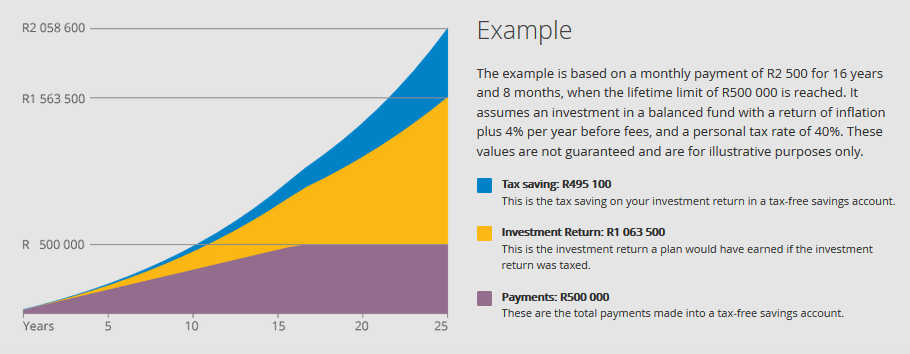
The chart below highlights this well. In purple, you have the payments, or contributions, to your TFSA over time. In this scenario, a contribution of R2500 a month will reach capacity in 16 years. The yellow shaded area highlights the growth in your portfolio if the returns were taxed at the assumed rate of 40%. The real beauty about TFSA’s is the blue shaded area. Imagine if you never got taxed at the 40% rate every year, you would have all that extra cash sitting in the market, earning returns. You’d be compounding on a bigger base. That’s the beauty of the TFSA’s. Over time, the benefit of no taxes + capturing big market days produces even great returns.

So i guess the next question would be, what was holding me back? Well I wasn’t sure of what the world will look like after that period. Imagine allocating capital for 14 years and having that capital not grow much due to something happening? That was the worry. I had anchored myself in the belief that the economy will not go anywhere and that there will be no returns anywhere. I’m pretty sure many people believe this given the current economic environment.

Now, the only way I know how to combat this feeling is with data, or some form of analysis that will provide me with some version of the truth. After all, what I am battling is bias and I believe that when you find yourself in such a space, you need to have tools that help ground you and give you a center that helps you find the truth. It also suits my personality in a way, given that I feel comfortable with data and numbers.

Now, this is where the cool charts come in. A document produced by MacroSolutions, called Long Term Perspectives, features some really good information on asset classes and provides some interesting charts that have lingered in my mind since I first saw them. These charts look at long term data and give some insight as to how asset classes perform over time.

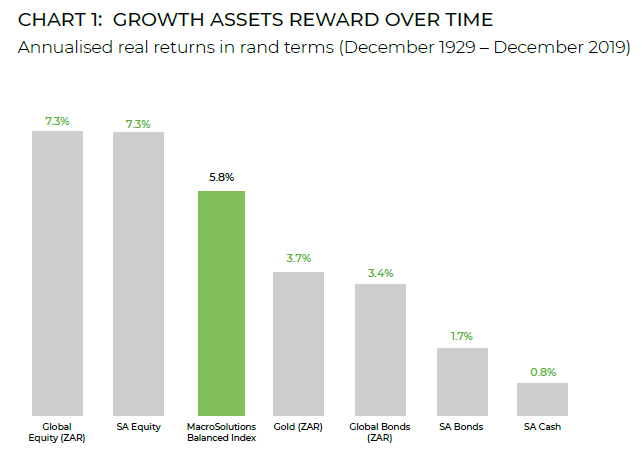
First chart is a reminder that over time, risk assets do indeed reward you. What is shown is the annualized real return of different asset classes over time. Global Equity and SA Equity have been the best performers over the 90 year period whilst Bonds, Cash and Gold returned much less. In green, we have the MacroSolutions Balanced Index, which is a fixed benchmark we use when looking at long term performance of a Balanced fund vs single asset classes. The green bar shows that a combination of different assets can lead to a better outcome over a longer period of time vs just holding Bonds or Cash or even Gold. It justifies the argument that over the long term, a portfolio with growth assets will outperform safe assets.

Second chart was also very interesting and perhaps the most interesting chart. It was a bit of analysis done where we looked at what your returns looked like if you had missed a particular number of “best days” in the market. The truth is, no one can predict the future repeatedly, people do get spooked when something crazy happens in the market, but what appears to be apparent to me is that panic is always against you. It’s all about the time spent in the market, versus timing the market which is a difficult task to get right over and over again. The chart shows that if you missed the 10 best days from January 1999 to December 2019 (just over 7300 days; so missing just 0.13% of all days in that 20 year period), your returns would have been almost 3% lower than what they would have if you had just left your money alone. And again, no one knows when these 10 days will happen with 100% accuracy, so trying to do so is very difficult and you’re much better off staying invested. Your risk of missing a big day is zero if you never take the money out because of fear!!!

The third chart is a reminder, that even when equities do have a bad year, the returns from the market tend to be positive over time, with some years being the real outliers. We confuse really bad years with the idea that what currently happens will carry on in perpetuity. I do admit that I am an optimist at heart, but when data stacks up like the chart below, it leads me to believe that my optimism is justified and that returns, over a long enough time horizon, do pay you for patience. What we need to guard ourselves against is the knee jerk reaction we get when we see some bad performance and believe that things are doomed to carry on as it is in the current moment.

This leaves me with the following conclusions:

  • TFSA’s allow me to capture extra return, if I just wait long enough. I just need to let the tax advantage accumulate over time. All the years of no taxation on my growth assets allows me to always have a pile of money that compounds without any seeing any drop in value coming from taxes, everything else remaining the same.
  • Time is my friend when it comes to TFSA’s. Not only for compounded returns, but also just riding out market volatility.
  • It’s about time in the market, trying to time the market is very difficult and leads you open to missing the really big days.
  • Taking advantage of the tax year roll over, meaning I begin investing as soon as the tax year begins and a fresh yearly limit of R36 000.00 allocation to the TFSA is allowed, allows me to capture more Time in The Market. This is exactly what I want given that I don’t know when the Best Days will arrive. So best be waiting in the waters when it does.
  • If I have a long time horizon + no taxes on returns + take on more risk = GREATER AFTER TAX RETURNS !!!!!
  • So the only thing I have to solve for is WHERE DO I TAKE THIS RISK that I intend on riding out for a long time, because the data shows that risk wins in the long term, and the stock market rewards those who stay invested because no one can time the market consistently forever.

The last point was the best insight for me, I solved the initial problem of allocation. Given what I have found, and the lessons I have learned, the conclusion seems to be, I should add the most risk in a TFSA because you get rewarded over time (in compounded, tax free returns). The data also shows that over time, risk assets outperform and patience is rewarded. This also solves for my bias, in that it protects me from making a poor asset allocation decision.

Now to go out there and hunt for opportunities 🙂

Until next time.

Thomo

Budget Review 2021: Singing all the right tunes, but is the crowd listening?

Welcome to another edition on Random Walk Theory. In today’s post we will be focusing on South Africa’s latest Medium Term Budget. We will have a look at what has occurred over the past year, what kind of policies and plans have been put in place for our recovery and some interesting charts that show where South Africa stands relative to global peers.

Firstly, I believe that the budget was positive in a sense that all our cards are out on the table. We acknowledge that South Africa is facing a bit of a constraint when it comes to our Government’s ability to tackle any more economic downturns in future. With a constrained budget, increasing debt service costs and low economic growth, South Africa’s debt dynamics do not seem favorable at all. What is positive is the understanding by Treasury that the economy as a whole will need some serious reform in order to get ourselves out of this structural issue. Once again, open and honest conclusions which I believe would benefit South Africa in the medium to long term.

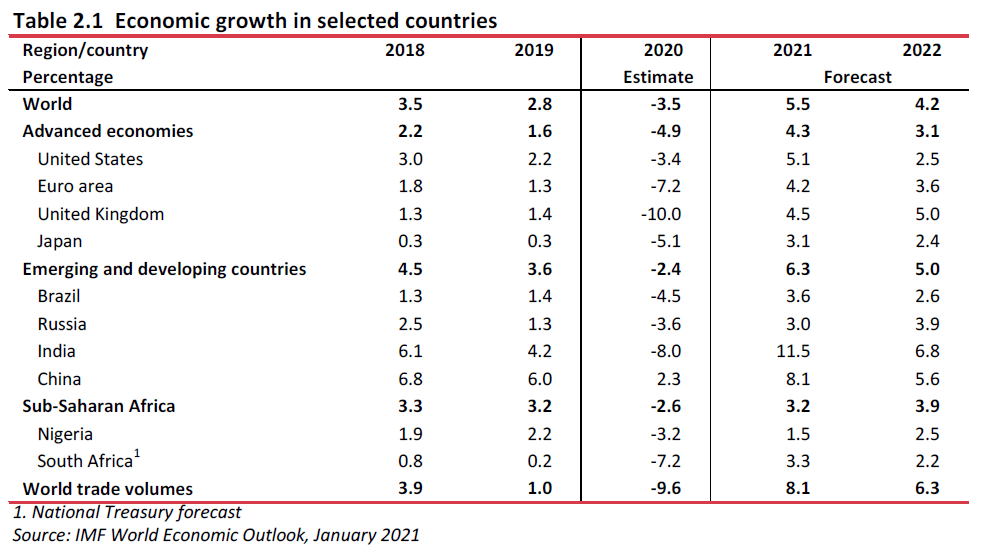
Beginning with global growth projections, we can see that South Africa is not expected to grow at a fast pace. This highlights some of the structural issues that are currently holding us back. With high interest rates and very low GDP growth, South Africa faces the challenge of having to find a balance of growing its capital expenditure whilst also being fiscally conservative, a mix that is difficult to achieve by any stretch of the imagination. We are predicted to have lower growth going forward than a lot of Developed Market countries which is alarming as we should be growing at a faster pace than those economies. The table below highlights this very issue.

Now to dive into some of the numbers and facts:

  • The debt figures continue to rise, but the picture has improved somewhat.
  • There appears to be a bigger focus on Capital Expenditure, which is positive for long term economic growth and capacity building.
  • The budget deficit has been revised to 14 per cent of GDP in 2020/21 in response to the spending and economic pressures of the COVID-19 pandemic. As a result, Gross debt has increased from 65.6 per cent to 80.3 per cent of GDP for the year 2020/21.
  • The 2021 Budget proposes measures to narrow the main budget primary deficit from 7.5 per cent of GDP in the current year to 0.8 per cent in 2023/24
  • The proposed fiscal framework will stabilize debt at 88.9 per cent of GDP in 2025/26. This is slightly better than what was expected back in October 2020 MTBPS.  
  • Government will roll out a free mass COVID-19 vaccination campaign for which R9 billion has been allocated in the medium term. This should be positive for the economy in the medium term as it reduces the need for further lockdowns if a large % of the population remains immune to the Covid strain. Where the risks lie are in the execution of a successful inoculation drive across the country.  
  • To support economic recovery, government will not raise any additional tax revenue in this budget. .
  • Gross tax revenue for 2020/21 is expected to be R213.2 billion lower than projections in the 2020 Budget. However, due to a recovery in consumption and wages in recent months, and mining sector tax receipts, 2020/21 revenue collections are expected to be R99.6 billion higher than estimated in the 2020 MTBPS.
  • As a result, government will not introduce measures to increase tax revenue in this Budget, and previously announced increases amounting to R40 billion over the next four years will be withdrawn.
  • The main tax proposals include an above-inflation increase in personal income tax brackets and rebates, and an 8 per cent increase in alcohol and tobacco excise duties.

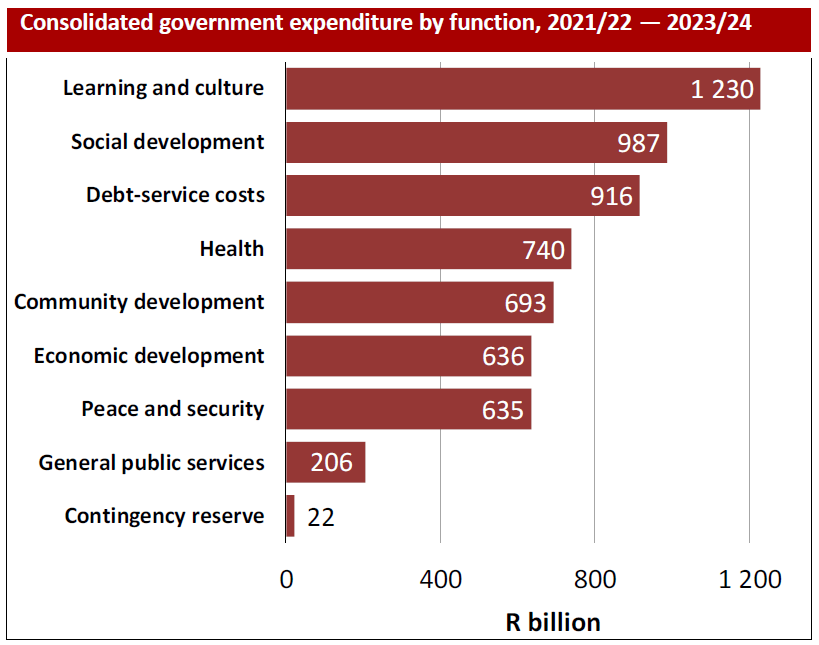
The fiscal position, which was already weak before the current crisis, has deteriorated sharply, requiring urgent steps to avoid a debt spiral. For several years, increasing debt-service costs have exceeded nominal GDP growth – a trend expected to continue over the medium term. The rate at which our interest expenses have increased has now created a large portion of our annual budget being spent on interest payments as opposed to increasing spending on either more capital goods (roads, infrastructure etc) or increasing spending on social services (education, safety, health)

If this does not change, the economy will not be able to generate sufficient revenue for the state to service debt. Over the medium term, debt-service costs are expected to average 20.9 per cent of gross tax revenue. This has been noted as a bad structural feature in our budget over the past few years and leaves us in a potentially tight spot. Debt-service costs will rise from R232.9 billion in 2020/21 to R338.6 billion in 2023/24. These costs, which were already the fastest-rising item of spending, now consume 19.2 per cent of tax revenue. Funds that could be spent on economic and social priorities are being redirected to pay local and overseas bondholders. Over the next three years, annual debt-service payments exceed government spending on most functions, including health, economic services, and peace and security.

To give a bit more color to the above situation, imagine that you earned R100.00 a year and you needed to allocate the R100.00 to all your expenditures. Now assume that you have some debt that needs to be paid off in a couple of years, and that you are currently being charged R10.00 interest a year. Therefore 10% of your salary is going towards interest payments (debt service costs) and the rest is split into other crucial expenses. Now, let’s imagine a situation where your interest costs increases due to interest rates rising, as well as the lender hiking your rates due to increased perceived risks (you’ve actually got more debt than you previously mentioned and you’ve started missing some payments). All of a sudden, you’re paying 20% of your income in interest payments and now have less money for the other crucial expenditures. Additionally, if you have emergency and need to further take on more debt, you’re less likely to be able to afford it over the long term and still maintain the amount of the stuff you need to spend on. Eventually you’ll need to reduce your spending on the other crucial expenditures as more of your income gets taken over by debt servicing costs. Either your debt needs to be consolidated or you need to make more money to be able to afford the current level of consumption + interest payments. This is essentially the situation Government is in right now.

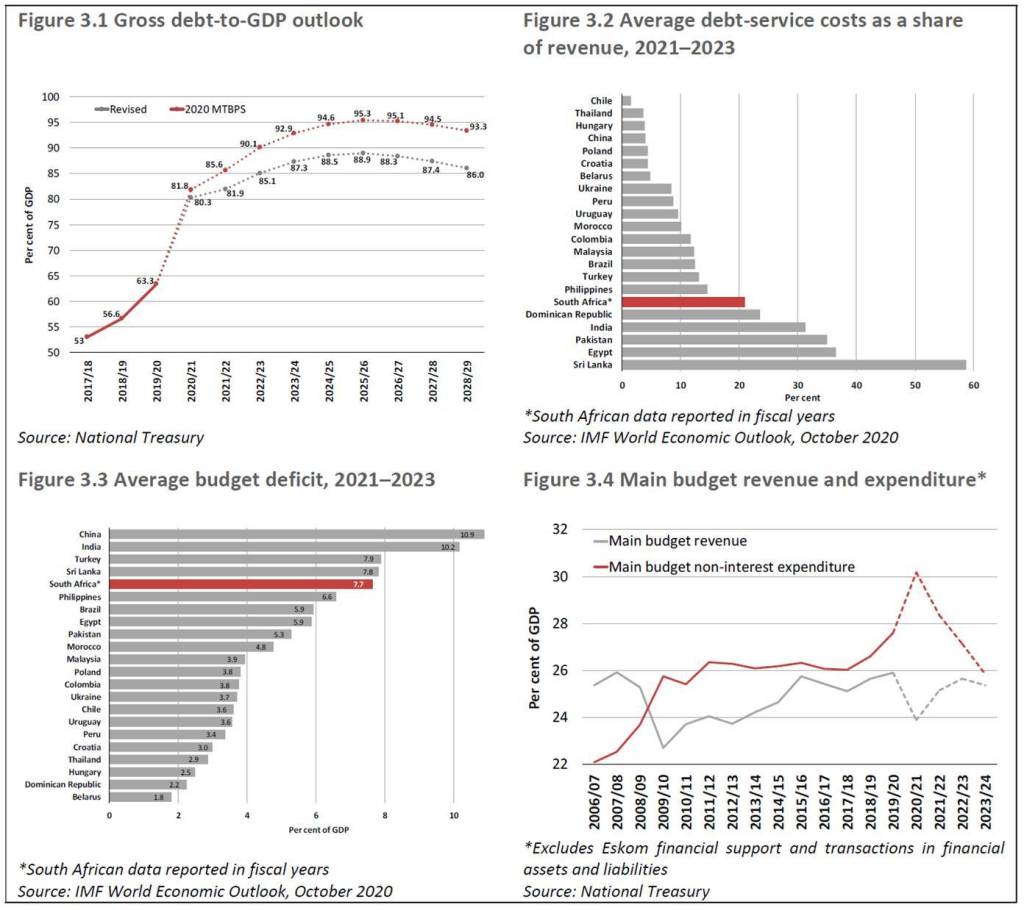
The graph below highlights where South Africa stands in terms of the current debt dynamics. Figure 3.1 highlights the slight improvement in our debt dynamics relative to what was projected in the 2020 MTBPS. We still have experienced a big spike in debt, but the rate of increase is expected to slow down as well as the absolute level (grey line lies lower than the red line). Figure 3.2 also highlights that we are part of a group of countries that have a large sare of the Government’s revenue being eaten up by debt service costs. The highlights that the interest rates we are paying on our debt is not sustainable, given our level of growth. figure 3.3 also highlights that we are set to have one of the wider budget deficits when compared to other peers. Again, not good given that this debt will continuously need to be serviced over time, and gives us less room to spend on other essential services.

Having a look at the other issue South Africa is faced with, the medium-term debt redemptions of state-owned companies total R182.8 billion. Without rapid improvements in financial management and the resolution of longstanding policy disputes – including the user pay principle – they will continue to put pressure on public finances. If these entities cannot support themselves and pay off their debt, then the Government will have to step in and add more capital into these business that aren’t doing well.

This is not feasible in the long term in my view given the constraint on the tax base. South Africans are already paying a a large share of their incomes to taxes, even by global standards. Relative to our economic wealth, South Africans pay a large share of their income in the form of taxes and compares closely to many “well off” countries, even though their citizens are much wealthier than ours. Expecting already constrained consumers to pay more is not a viable option without growth. We already have a small portion of the population contributing to Personal Income tax (about 7million people actively pay Personal Income tax vs a population of about 60 million) and the political will to hike VAT rates is low given how sensitive the majority of the country is to changes in VAT.

The image below shows South Africa relative to other countries globally. The horizontal axis represents the amount of personal income tax as a % of GDP. The vertical axis shows each country’s highest Personal Income Tax (PIT) rate. South Africa currently lies in the top right hand corner of the chart, highlighting that we have a high top PIT tax rate as well as high overall average taxes. The mismatch is clear given that this region is mostly associated with richer countries whilst peers who are similar to us have much lower PIT tax as a % of GDP and lower top tax rates.

·      

In summary, it appears that South Africa will either need to get growth up or consolidate on its expenditure, which is a very difficult thing to do. We cannot forget that South Africa has a large portion of people currently employed by the state and any shedding of those jobs will be bad for consumption everywhere in the country. This is highlighted in the budget and the acknowledgement of how difficult consolidation will be leaves mes me to believe that the focus should be on growth enhancing policies without breaking line on the expenditure side. This will need capital to be “crowed in” or rather, Government will need to allow investors to take some of the risks themselves and take away some expenditures and costs the government currently has on its plate. Privatization could be one avenue for some state assets but allowing some blended mix of financing for future projects can allow Government to bear less of the risks whilst being able to consolidate on its expenditures.

After all, that is the point of capital markets in my view; it’s a place where you can find players (investors) who are willing to take on and fund risky projects, or a portion of it, for a particular price. If government allows private participation in certain projects, it allows some of the risk to be held by people who are willing to take on the risk.

Hope this note was insightful and has given some interesting perspectives on the Budget.

Until next time.

Thomo.
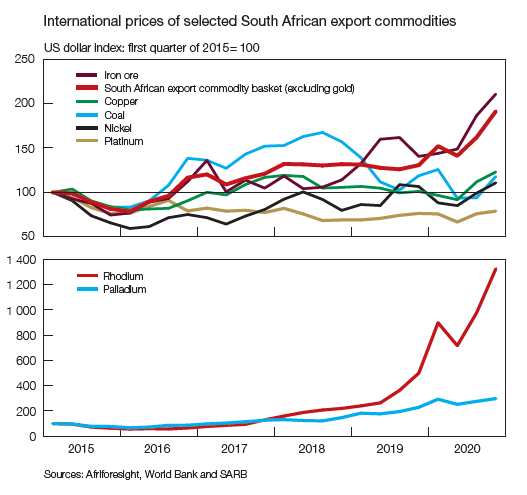
Life is the River, Choice is the Rudder

Welcome back to another edition of Random Walk Theory. Glad that you have made it this far into the journey. It’s officially been a month since this blog started and I would like to take this time to say thank you to all the readers who have left comments, reached out to me and everyone else who’s simply just taken time out to read some of these posts and share with friends and family. Keep on sharing the posts and website. Keep those comments and interactions going. Let’s keep growing this !!!!

Today we will be discussing the idea of Choice. I’ve been musing on this idea for some time now and it has taken me several iterations to finally distill some sort of coherent post on my thoughts on Choice. After repeating it a couple times to a few of my friends, I’ve settled on the idea of Life being a River, and the only tool we have to navigate it is Choice, the rudder to our metaphorical boat through which we navigate life in. You, and you alone hold the power of your own Choices. A bit philosophical, but that’s what rainy Sundays along the Liesbeek River are meant for right?

Image result for choice

A couple months ago I was chatting to long time friend of mine (when I say Long time friend, we cannot exactly place how and when we became friends, and that our parents know each from their Primary/High School days), Vuyo Tsotsotso, and we were just reflecting on a rather difficult September for the both of us. We were both having a tough time at work and we also just had, what we thought, a streak of bad luck in life in general. Of course, during the thick of things, you fail to see any way out and things can look gloomy. IIt’s is very easy for the mind to focus and latch on to things we believe are the biggest problems out there in the world. The mind’s ability to zoom in and fixate on things deemed “important” will never cease to amaze me. After a bit of reflection, some light hearted teasing and affirmations, we were all smiles and full of laughter. We were relatively upbeat after our discussion because we were able to make light of our situations and realized that we do have to consider that on a net basis, we were okay; things could be worse.

After the discussion, I began to really think about what just happened. The mere fact that we could just talk each other out of our funks was really cool. I realized that what changed was what we decided to focus on. What happened was that we “chose” to focus on the positives, but were also cognizant of the negatives. And although very basic, I realized that that’s all we have really in life, we have Choice. That is the one true thing that we have actual control over. Choice is the only tool we have in navigating life.

Image result for river

Now, for the metaphor… I thought about life as a river. Now, when one thinks of a river you need to consider all its aspects for this metaphor to truly hit. A river is both serene but has the potential to be turbulent and difficult to navigate. A river has both calm and rapid waters. As a single human being, you cannot control the way in which a river moves and flows; it has its own path that it follows that no one has any direct impact on its way of coming to being (broadly speaking). From this perspective, the river’s behavior and way of being is neither personal to or does it go out of its way to change for you. Life has similar aspects in my view.

And now for the boat. Imagine a regular wooden boat. To propel this boat up against the flow of the river would require a lot of resources and tools. You would need a substantial amount of fuel, need a set of tools and technical know how to fix the engine in case it fails at some point, or to just perform regular maintenance. It soon becomes a difficult task to do, on a long enough time horizon. From this deduction, it becomes a futile exercise when you look at the amount of work needed to continuously go up against the river. Therefore, its best to just flow with the river, as opposed to fight against it. Again, I view this as a principle of life as well. Going against the flow of life and not accepting the flow of it is a difficult task to do over a long enough time period, so its best to try and navigate it whilst flowing with it, not against it.

Now, for the final piece of the puzzle, how do you navigate such a boat in a river? Well, the best tool would be a rudder. For those of you who may not be familiar with a rudder, a rudder is a primary control surface used to steer a ship, boat, submarine, hovercraft, aircraft, or other conveyance that moves through a fluid medium. For those of you who are more “30 Seconds” inclined, its the thing on the back of a boat that looks like a fin; usually used to direct the boat.

Image result for forest

I like to think of the Rudder of Life as Choice. We each have a rudder and we can decide where to steer our boat to whilst traveling down this river called life. We can decide to steer ourselves to relatively calmer waters or decide to stick it out in the difficult rapids. We all have that ability, what is scary for most is realizing that they do in fact hold that power to choose. The idea of acknowledging that one is wholly responsible for what they decide to do is still quite daunting to a lot of people or rather, the concept of it is lost to a lot of people. It comes with a feeling of a lot of pressure. A “power” too big to manage. I this avoidance or fear of this “power” is what makes people so opposed to the idea of fully accepting responsibility for their choices.

However, I do feel that there are reasons for this. What’s also important to realize is what are the influences in making the choice. That’s the tricky part. It’s the knowledge of self. It’s knowing, and accepting why you are making the choice that you are making. It’s the influences that have made you choose one thing over the other, why you decided to procrastinate, why you decided on not taking that chance. That is where the heart of all of this is, it is the understanding of what drives the choices you make and why is it so.

Perhaps this is what people fear the most. The amount of work needed to truly accept and understand the influences and influencers who have shaped their process in making their Choices.

Image result for path

I’ve been on a bit of a war path with this idea of choice, and have been telling a few close friends of mine that we need to realize that Choice is the only thing we have, and it is our responsibility to know why we make the choices we make. You are responsible for being the captain of your own ship, and you need to decide which waters you are going to tackle and which waters you will avoid. Understanding why you made those choices is another important thing to be aware of. Life without this knowledge, is like Death in disguise.

Life is the River, Choice is the rudder; you need to be in control of the rudder as the captain of your ship. The waters await.

Until next time,

Thomo.
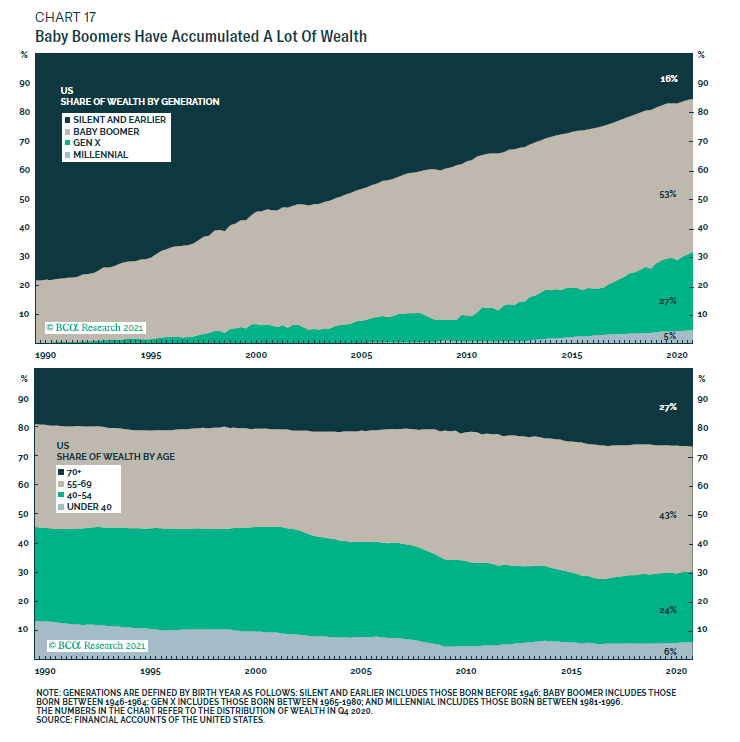
South African Government Bonds: Inflation Linked Bonds

In today’s Financial education segment, we will continue on the topic of South African Government Bonds. We will be discussing a different type of Government Bond that investors can use to protect themselves against the adverse effects of inflation. Today, we will be discussing Inflation Linked Bonds. We will discuss what they are, how do they work and how I think about the asset as part of a portfolio.
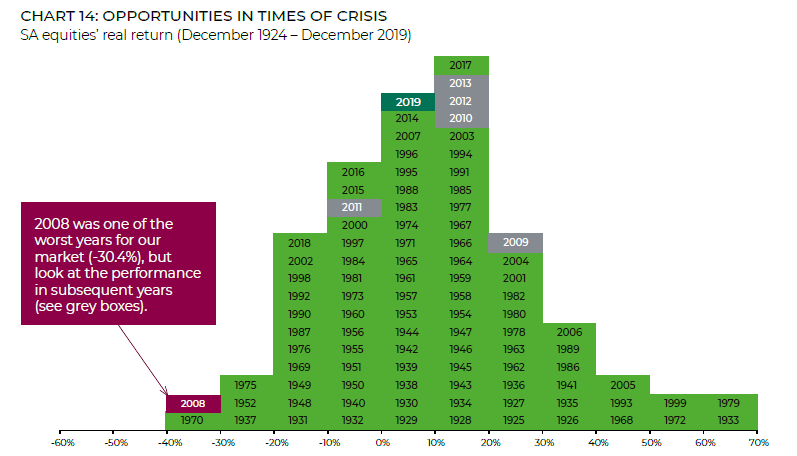
Once again, I need to highlight that the information and views expressed in this post are my own and do not constitute as financial advise.
Before we begin, I’d like to have a basic introduction or refresher as to what inflation is. Inflation is the decline in purchasing power in a given currency over time. The rise in the general level of prices, often expressed a a percentage, means that a unit of currency effectively buys less than it did in prior periods. Inflation can be contrasted with deflation, which is the rise in the purchasing power of a currency increases and the cost of goods falls.

To give you an idea of how inflation works, here’s an example below showing the impact of inflation on your savings if you are earning a negative real return. Recall, the real return on your investment is the return you get after accounting for inflation. It is the change in your purchasing power.

The chart below, sourced from MacroSolutions ‘Long Term Perspectives 2020’ document, demonstrates how your purchasing power declines with higher levels of inflation through time. The gold line shows how the decline in your purchasing power occurs when inflation is 3% per year. As you can see, after 30 years, your initial investment of R10 000.00 will have an equivalent value of R4 120.00, a decline of just shy of 60%. The same effect is much worse when we have inflation at 6% per year (light green line). Over the same period, you will see your initial investment now sitting at an equivalent R1 741, a decline in purchasing power of close to 83%. At 9% inflation (dark green line), you lose close to 93% in purchasing power.

In short, inflation is the invisible enemy that investors always need to be wary of. Returns should also be considered in real terms and not just in nominal terms. The goal should be increase purchasing power and not just focus on nominal returns.

Now, back to Inflation Linked Bonds…

  1. What is an Inflation Linked Bond?

An inflation-linked bond is a bond issued by the government where the coupon payable and the principal amount payable at maturity of the bond are linked to inflation. On maturity, the capital amount paid out is also linked to inflation. If there was deflation over the term of the bond, the principal amount payable at maturity will be no less than the initial nominal value of the bond.

The bonds offer a guaranteed real return that is known at the outset, if held to maturity. The coupon rate is a fixed percentage of the principal amount, adjusted for inflation, payable twice a year.

2. How it Works?

An index-linked bond is a bond which has its coupon payments adjusted for inflation by linking the payments to some inflation indicator, such as the Consumer Price Index (CPI).

Your investment in these bonds will increase in value every six months in line with inflation (being the general increase in prices as measured by the Consumer Price Index announced by Statistics South Africa). This process is known as index linking. In addition to this inflation adjustment on the amount invested, you will also earn further interest on your investment, payable on specific interest payment dates. The investment will earn interest at a six-monthly fixed real interest rate (this is the difference between the nominal interest rate and CPI rate). This rate is derived from government’s inflation linked bonds yield curve, as traded on the JSE (Johannesburg Stock Exchange) and calculated separately by the National Treasury for the various terms. The combination of index-linking and a fixed interest earned on Inflation Linked Bonds means that your savings are guaranteed to grow ahead of the rate of inflation.

Principal and Coupon Value, From Issuance to Maturity

In essence, your capital invested is adjusted for inflation over time, and every 6 months when interest is due, your interest amount is based off the adjusted capital value of your investment, thus increasing your interest payments above inflation, given the fact that your coupon will already account for a change in inflation.

3. How I think about the Asset

Currently, with inflation expectations below the midpoint of the SARB’s midpoint target, I am not especially worried about inflation. As shown in last week’s post, inflation expectations are muted and a lot of market participants are not expecting any inflation pressures over the next few years.

With that being said, Inflation linked bonds are offering a lot of value at close to 5% real yields on offer. This is quite cheap relative to history (remember, there is an inverse relationship between yield on a fixed income instrument and the price; the higher the yield, the cheaper it is and visa versa). It is a good idea to be picking up inflation protection at current levels but I am still a fan of Nominal bonds vs Inflation Linked Bonds.

After all, no one can predict the future so its always a good thing to buy protection whilst its still cheap to do so…

Until next time 🙂

Thomo