South African Government Bonds: How I think about the asset.

This blog post will be highlighting how I think about Government Bonds and my approach in thinking about them. The previous post was an introduction into what Government Bonds are, some key information as to how they work and some of the risks associated with investing in them.

When I think about Government Bonds I always link it to how much yield I am getting above inflation. The difference between the nominal yield and inflation is called the real yield. It is the increase in purchasing power you should be getting on your investment. A simple rule that I always use when thinking about where to invest my money is how much return am I getting above inflation, as I am interested in growing my purchasing power over time. I will clarify this concept with a simple example.

Imagine you had R100.00 and you had 2 options, either invest the money or use it now and buy a set of earphones (assuming you can get a pair of earphones for R100.00). Now let’s assume inflation is 5% per annum and a Bank Savings Deposit offers you 4% interest per annum. In a year’s time, you will have R104.00 in your Bank account but now, the earphones cost R105.00. You cannot afford the earphones, which is a shame because a year ago you could afford them. This is an example of a loss of purchasing power. Your investment did not beat inflation and you cannot afford to buy goods and services that you were able to afford a year ago. This is why I always aim for a real yield that is positive and not negative.

Now, coming back to the SA Government Bonds…

The reason why I still like buying Government Bonds is because the current real yield on SA Government Bonds is really high, relative to its own history. The current SA 10 Year real yield is 6%, and from the chart below, you can see that the yield has not been this high for almost 20 years, at least not for long enough time periods. South Africa’s nominal yields reached levels close to 20% during the late 1990’s as the Asia crisis occurred and sent ripples of fear into Emerging market currencies and Interest rates. So I’m getting a pretty good yield on SA Government debt since the yield hasn’t been this high in a while.
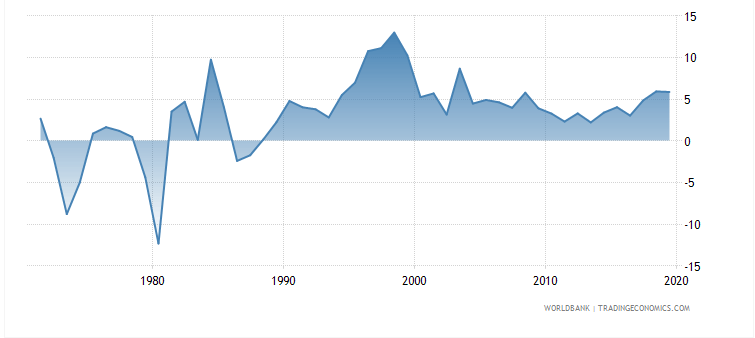
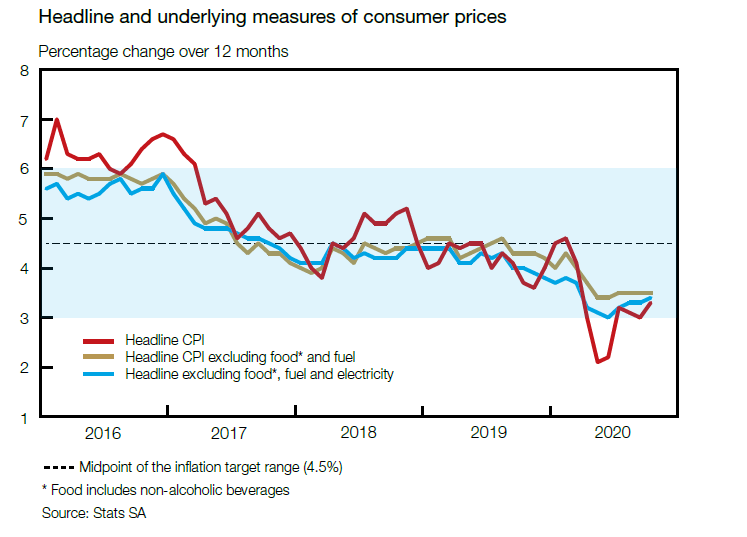
I’m also a big fan of Bonds at the moment because of the inflationary environment. Inflation is coming in pretty low, and without much pressure in the near term. This is positive for bonds because the real yield you get is quite high. With inflation being low, the real yield on SA ALBI Bond Index is close to 6% currently, which is also high relative to history. Below is an image from the SARB’s Quarterly Bulletin (December Edition, 2020) and shows the inflation profile of South Africa over the past few years. In my view, we will stay at this level of inflation for the next couple of months, as the economy slowly gets back onto its feet.

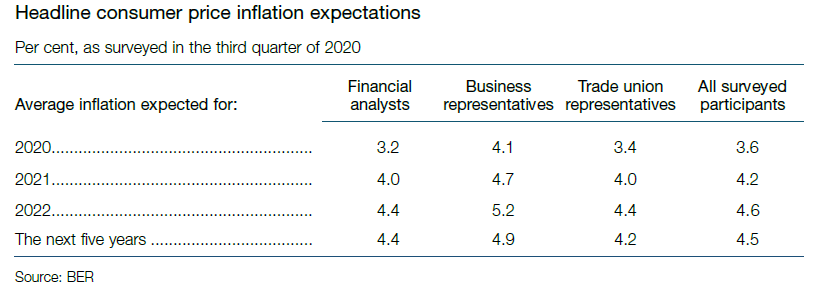
Market participants are also expecting inflation to remain close to 4.5% over the medium term. Below is a table highlighting inflation expectations by different interest groups. Financial analysts are expecting an environment of inflation being lower than 4.5%, as do most groups besides Business representatives; they view it possibly a few basis points higher. Not a materially meaningful difference in my view. These are soft inflation expectations at best in my view.
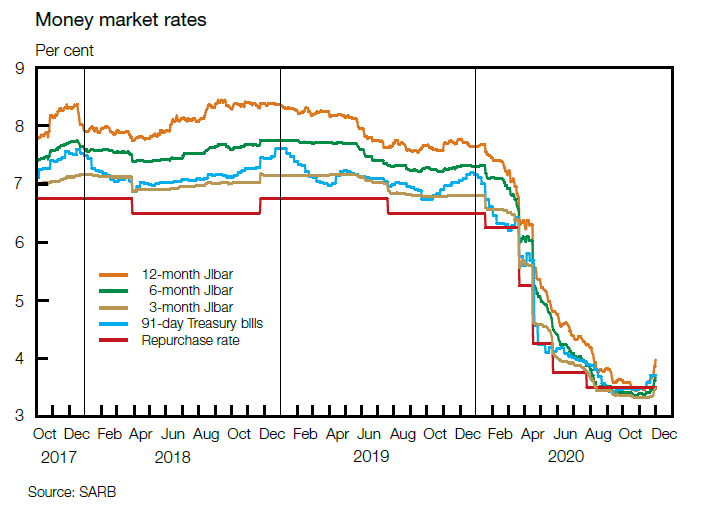
Now don’t get me wrong, I do acknowledge that Government has a lot of debt on its books and the amount of money that needs to be dedicated to Eskom and the like is huge, but at these levels in interests rates, and given how low the Repo Rate is, this is a great opportunity to pick up high yield without taking on additional corporate risk.

Bank deposits at banks are offering very low rates and the chances of earning inflation beating interest is low, so Bonds win in that regard as well. The graph below shows Money market rates. This is what most Money Market Deposits at Banks offer to clients. The lower the Repurchase Rate (Repo Rate), the lower the interest clients can expected to be generated in their Savings accounts. This rate has gone from 8.5% down to around 4%, almost half of your expected returns has been wiped out.
Low inflation means high real yield and most market participants are expecting an inflation level of close to 4.5%. This should mean that with bonds even staying at 9.3%, we get a 5% real yield expected return, which is quite high.

Also, according to theory, a Government bond is the safest asset in a country given the fact that the Government can technically never run out of money. So you implicitly have the safest asset in South Africa offering the highest real yield it has in almost 20 years and is expected to maintain this level of return as long as inflation remains well behaved, and given the current environment, it is expected to.

To me, the easiest trade in the world.

South African Government Bonds: An Introduction

This month’s learnings and insights section will be covering Government Bonds. It’s been an asset that I’ve been a fan of for a couple of years now given the current level of return one can receive on them. I’ll be splitting these posts into 3 parts. The first section will be a brief introduction as to what Government Bonds are, the second section will be a quick analysis and how I like to think about SA Bonds and the final section will include how I view them as an asset in my current mix of assets.

A reminder that this does not constitute as financial advice and all the views held are my own. This is simply my own views on SA Government Bonds and how I think about them.

  1. What is a Government Bond?

A government bond is a type of debt-based investment, where you loan money to a government in return for an agreed rate of interest. Governments use them to raise funds that can be spent on new projects or infrastructure. When you buy a government bond, you lend the government an agreed amount of money for an agreed period of time. In return, the government will pay you back a set level of interest at regular periods, known as the coupon.

This is one of the advantages of owning Government Bonds, in that they have stable, predictable cash income. Once the bond expires, you’ll get back your original investment and final interest payment. The day on which you get your original investment back is called the maturity date. Different bonds will come with different maturity dates – you could buy a bond that matures in less than a year, or one that matures in 30 years or more. Just like shares, government bonds can be held as an investment or sold on to other traders on the open market.

The way in which you can access them is through either an ETF or a Unit trust. There are plenty of asset managers in the country that have Bond funds that can help you get this kind of exposure. These products are managed in such a way that there is no “maturity date” and these products can be held for many years. Instead of holding one type of Government Bond (one bond with a fixed maturity date), these funds are constructed in such a way that the investors will hold Government Bonds with different maturity dates and will always have exposure to Government debt.


You might hear investors say that a government bond is a risk-free investment. Since a government can always print more money to meet its debts, the theory goes, you’ll always get your money back when the bond matures. In reality, the picture is more complicated. Some Governments have defaulted on their debts and failed to meet their obligations to investors. In general, Government Bonds are looked as the safest asset due to the fact that the government will make the payments, even if it needs to hike taxes to collect more money to pay off its debts. That’s where the “safety” comes from.

2. What is Yield to Maturity?

The yield to maturity is the rate that your investment will yield over the life time of your Bond. There is an inverse relationship between a bond’s yield to maturity and the price. If the yield goes up, the price will go down and visa-versa. Various economical, internal and external factors e.g. the inflation rate, GDP, the currency etc. will influence the yield to maturity on a daily basis. High interest rates are usually indicative of investors finding something worrying in a country. There may be heightened political issues or tensions, a precarious budget deficit position or some other perceived riskiness in allocating money to the borrowing country.

There also tends to be a good correlation between a higher credit rating and lower interest rates. Countries that are perceived to be safer based off of certain credit metrics will pay lower interest rates on their Government Debt; whilst those that score negatively on these credit metrics tend to pay higher interest rates on their Government debt. Supply and Demand dynamics also have a significant impact on yields. If there is a large demand for Government Debt, then investors are willing to accept a lower return on their investment (i.e. they’ll charge a lower interest rate on the debt). The opposite is true when there is an oversupply of Government debt; the debt needs to be priced attractively enough for people to invest. (You’d loan them more money if you can receive a higher return for the level of risk you’re taking).

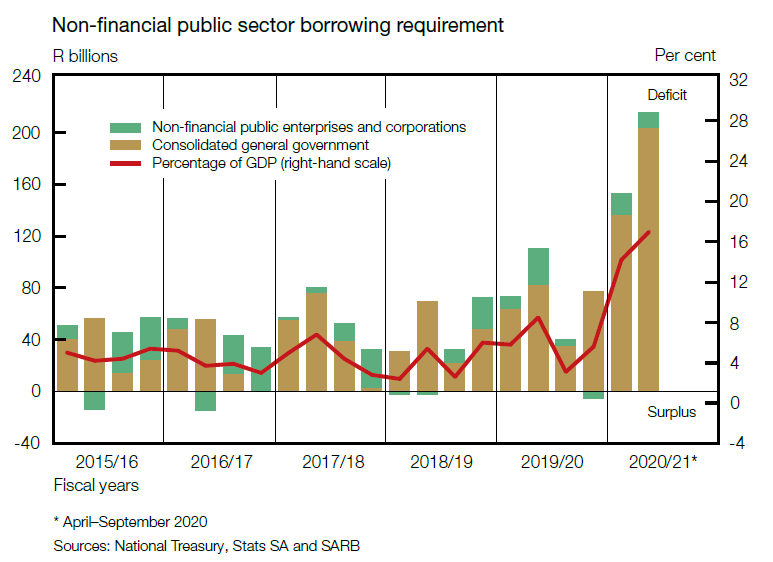
Below is an idea of the borrowing the South African Government + Public Corporations require for the next year. As you can see, the borrowing requirement has increased quite dramatically. The government now needs to borrow close to R200 billion for this year’s expenditures due to Covid lockdowns, fall in revenue collections and increased support required for the economy.

3. Key Risks

Aside from credit risk (the risk that the person/entity you’re lending to cannot pay you back), there are a few other potential pitfalls to watch out for with government bonds: including risk from interest rates, inflation and currencies.

Interest rate risk is the potential that rising interest rates will cause the value of your bond to fall. This risk is magnified by the Modified Duration of the bond. Modified Duration is the Bond’s sensitivity to changes in the interest rate. If the modified duration of a bond is high, then the impact of a change in interest rates is higher (if rates rise, the impact is negative, if rates fall, the duration impact is positive). Inflation risk is the potential that rising inflation will cause the value of your bond to fall. This is because with rising inflation, the real return on your Bond decreases. If the rate of inflation rises over the yield to maturity of your bond, then your investment will lose you money in real terms. Inflation-linked bonds can help mitigate this risk.

In summary, a Government Bond is a debt instrument that the Government uses to fund itself. As an investor, you’re able to invest in this (that is, you’re able to borrow Government money) and receive interest from them (called a coupon). What matters is inflation risk (how inflation ruins your purchasing power) and credit risk when thinking about Bonds as well as interest rate risk itself (how changes in interest rates affect the value of your bond; think about the inverse relationship mentioned earlier).

In part 2, I’ll be diving more into some analysis and how I like to think about SA Government Bonds…

Stay tuned

The 5 Hindrances of Self Mastery

I recently came across some really interesting YouTube channels that discuss dealing with anxiety and self-mastery. I wanted to get a better understanding on the topics and also get some useful tips on how one can deal with any event that may trigger some anxiety. There is an abundance of YouTube videos available on almost anything these days and I find it to be a great place to find information on just about anything.

Out of all the videos I watched, one stood out in particular. The 5 Hindrances of Self-Mastery discussed by Master Shi Heng Yi at a TED Talk event seemed to have the right message at a time I needed to hear it the most. I found everything he said very insightful and true in terms of what has been going on in my life.

We all have our own demons and internal battles that seem to creep out of nowhere and wreak havoc on our minds and lives. We get lost in our minds going back into the past critiquing events that happened, what we should or should not have said or whether we made the right or wrong decisions. These thoughts can keep us on a perennial loop of self-doubt and fear. We also travel into the future and worry about things that have not occurred yet. Things that aren’t true or real for the mere fact that they have not occurred.

I’ve learnt that the mind gets distracted by such things but you are able to gain control and not fall into the trap.

  • Being able to pull yourself out of the bubble and really understand where these feelings and thoughts are coming from is the first step. You need to recognize when these feelings or thoughts are coming up and try and figure out what the root causes are.
  • Accepting things for what they are and what is happening is the second step. This could be with a particular task, event or even a person. I have a view that Life is not personal, and we should not treat it as such.
  • You also need to be able to figure out what is the consequence or the result if you stay in that feeling or thought pattern. Being able to recognize where this feeling or emotion will take you is important because it almost brings back an element of “control” in that you need to know where it can take you and making the decision to follow through or not.
  • That level of accountability to yourself is important. You need to understand that it is your choice to be proactive or reactive to the emotion, thought or person who is causing the feeling or emotion to come up.

Being able to understand all of this and recognizing that you are not your emotion or feeling is how I’ve gained more perspective and clarity on things. Being able to recognize that has provided me with the level of clarity that is needed to navigate the world we live in. It’s also been a massive help in understanding when I am making decisions based off of an emotional state or not. Knowing where you are mentally and emotionally is crucial when it comes to making investment decisions as we are all prone to bias.

I want to share the 5 hindrances and my interpretation of each one.

  1. Sensual Desire
    – Anything that arouses the senses. Anything that leaves its impact on the mind via taste, smell, sight or touch.
    – I can summarize it as materialism and earthly objects.
    – Any obsession with these, or a deep love for it will deter you from seeing the truth. You become a slave to it. It rules you.
  2. Ill Will
    – Describes a state of the mind that arises from negative emotions.
    – In that state of the mind, you have an aversion, a rejection or simply a dislike against either object, a situation, or even a person.
    – A strong dislike for any situation or object can deter you from finding the clarity you need in life. Things or people cannot stop you from doing something simply because you do not like it/them.
    – There will always be things/people we don’t like. If you let this determine how you operate or go about doing what you want, then you are doing a disservice to yourself.
    Searching for Clarity, Newsletter No. 02
  3. Heaviness of the body; Dullness of the Mind
    – It is characterized by sleepiness, non-motivation, lack of energy and often times can manifest itself into a state of depression.
    – Your body is a temple. You need to treat it as such. Without the maintenance and training it needs, it performs in a sub-optimal way.
    – The mind is a muscle that needs to be exercised and kept in shape. A dull mind is the devil’s playground.
  4. Restlessness
    – An unsettled mind either is worrying about the future or traveling into the past. And rejecting, judging an event that happened into your past.
    – A simile used here is the monkey mind. Constantly jumping from one branch to another, unable to stay for too long time at the present moment.
    – The problem is there is no time to see clearly anymore. A distracted mind cannot co-ordinate thoughts properly.
    – Restlessness leads to analysis-paralysis. You just end up over-analysing situations and end up not doing anything.
  5. Skeptical Doubt
    – It’s very closely related to a state of mind, which is based on indecisiveness. It is very easy in that state of mind getting lost in thoughts.
    – ‘Can I do this? Is this the right path? What will the others say? What if this, what if that?’
    – The mind cannot synchronize with your own actions, anymore. And the result is that you are getting disconnected with the goals and aspirations that once you have said to yourself.
    – When the way is filled with too much doubt, more often you will stop, instead of moving on.

These 5 mental states will pull you off of your Life path. They distract you and take you away from living a good life. What is vital for all of us is to develop the ability to not get bogged down in these states. We need to structure our lives and develop habits that assist us in getting us out of these states as well avoiding them completely. It’s something I am continuously learning, but I can say that it is possible. The first step is to “Accept the Bottom”. Only once you bottom can you start building and moving back up.

Till next time,

Thomo

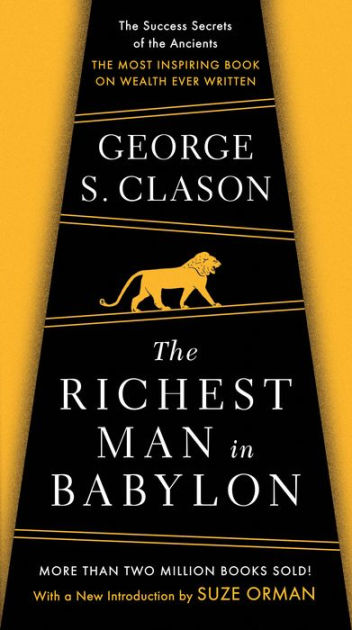
Lessons: The Richest Man in Babylon

I read a book some time ago called “The Richest Man in Babylon” and I must admit that before buying the book, the title did get my tongue wagging. I thought that it would be a “quick guide” to all things finance and fast track my understanding of investments.

Although it fell short of what I was looking for, I did pick up more philosophy out of the book than anything else. Some of the stories in the book are worthwhile and I would encourage those of you who are interested to have a look at the book.

Key take-always I got:

  • If you desire to help your friend, do not do so in a way that brings their burdens onto you. There are many ways to help people. You don’t have to choose the ways that restrict your time, money, energy, or ability to care for yourself.
  • The wise lender always has a guarantee of repayment should the investment go poorly.
  • Above all you should desire safety for your money. Better a little caution than a great regret.
  • Youth often assumes, incorrectly, that the old and wise only have wisdom about days gone by.
  • You will only begin building wealth when you start to realize that a part of all the money you earn is yours to keep. That is, pay yourself first. You always pay others for goods and services. Pay yourself as much as you can. Save money.
  • Enjoy life while you are here. Do not over burden yourself with the duty to save.

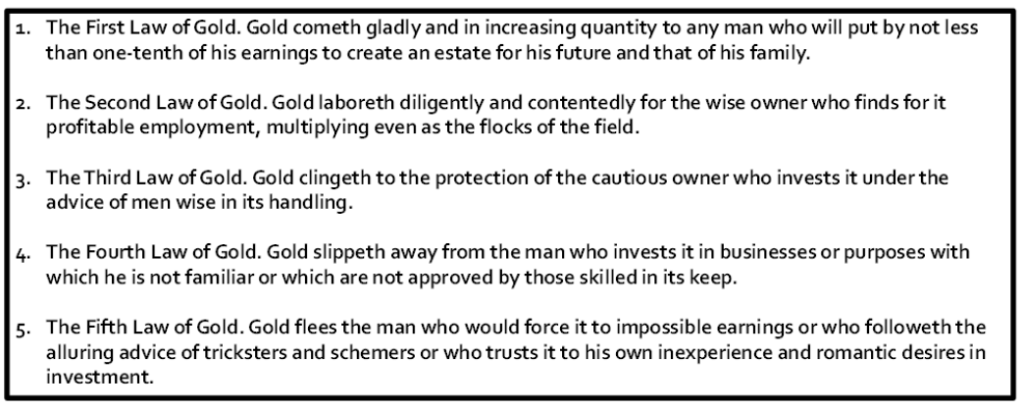
A particular section was so good that I wanted to share it for post. I’d like to think that I can leave something useful in every post. I’ll probably be using these laws in future as a reference. These laws are pretty good in terms of figuring out good habits when saving or thinking about your investments. I do believe that investors need some sort of compass that guides their investment thinking and process. We need to believe in core principles when investing, otherwise it feels pointless. I use these in my philosophy when thinking about my personal investments and finances.

The 5 Laws of Gold:

Developing conscious habits around how we view and use money is the first step in being aware of your personal finances. You need to be deliberate in the ways in which you use your money and how you choose to invest it. Consideration and careful thought should always be put into any investment decisions.

Hopefully some of these points and lessons have given you something to think about.

Until next time

Thomo

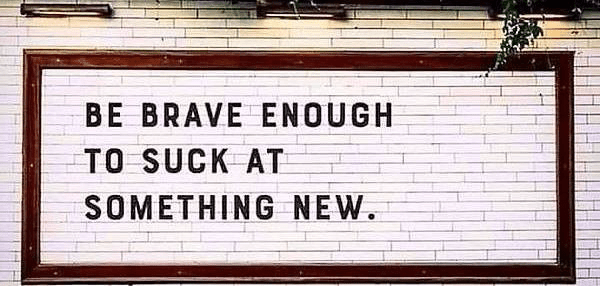
Be brave enough to suck at something new

This is the first time I’ve ever written a newsletter/blog post, or made an attempt at one. If you’re reading this, you are one of the first few people brave enough to read this, so congratulations and thank you for being part of my first mailing list (I’ve never had one before, feels pretty cool hahaha.) As the saying goes, things get better with time, and I’m hoping the same goes with my writing and this newsletter.

I want to use this blog as a way of covering one of the more interesting topics I’ve come across. Personal Finance. It amazes me how many people have not properly spent time on looking at their personal finances, let alone fully understanding what is going in their retirement funds and personal investments. I don’t declare to be a pro, but I do believe that I’ve done some work on the subject and would like to spread some of the gems I’ve come across over the past few years on this journey. As time goes on and my knowledge base expands even more, I hope that the learnings I come across become as useful to you, as they have been to me.

I also want to use it as a space to discuss philosophy, and other interesting topics I may come across or think about from time to time. The core messages will most likely rotate around finance and investments, but I do believe being able to venture into other schools of thought is important if one wishes to navigate the world of finance and truly understand things for what they are and not what we wish them to be. Sounds messy, but atleast that is step closer to reality.

I decided on calling this blog “Random Walk Theory” because the name suits my ritual of going for walks when I need to think. I tend to get a lot of my good ideas when I am walking around my neighbourhood or anywhere for that matter. To give a more technical description of the idea:

‘A “random walk” is a statistical phenomenon where a variable follows no discernible trend and moves seemingly at random.’

Allowing one’s mind to venture of into different rabbit holes brings many weird and wonderful thoughts. Never formal, always random and unpredictable. I think the phenomenon, as described in Financial literature, fits this tendency quite well.


Of course, comments and suggestions are welcome. Getting feedback from readers is definitely something I want. Any recommendations on how this can be improved are greatly appreciated.


Hope you enjoy 🙂